Middle East News Analysis
Arab Realignment:
Reactions to the Lebanon Crisis indicate how much political developments in Iraq have started a strange realignment in the Middle East. It is essentially a realignment of governments, not necessarily of peoples. President Bush's Iraq 'experimment', or blunder as many outside the United States call it, has had the surprising effect of bringing many Arab regimes and Israel together. This process itself was probably inevitable, given the futility and failures of the successive Arab wars with Israel, and the increasingly stale flavor acquired by the old official argument that Arabs cannot have democracy until after the Palestine issue is resolved. This last argument is being dusted up again and recycled now by many Arab rulers as they bide their time and await the end of the Bush presidency and the possible ascendance of a more mellow Democratic administration. There seems to be no fear on that score, for the Bush administration itself now seems to have been worn out by the political wars of attrition waged by its major Arab allies against its now seemingly-abandoned calls for democracy.
The results of the Iraq elections, and the coming to power of the Shi'a (Shiite to some of you foreign ajnabis) majority have disturbed the power structure in the Arab Middle East. For the first time in modern history Shi'as have gained control of a major Arab country, and what makes it even mor ominous as well as painful for the power structure, they have done it through free elections of the kind never seen in the Arab World. Underscoring the unease is the worry that the parties in power in Iraq have good relations with Iran. That is of course true, if only because until recently Iran was the only regional destination that welcomed exiles from the Baathist gulag, while most Arab governments and their media at the time were hailing Saddam as the new Saladin- ironically, the original Saladin himself was a Kurd.
Which brings us to the current situation in Lebanon. Hizballah's blunder- it seems like a blunder as of this moment, unless Israel commits an even bigger blunder, something that it has done in Lebanon in the past- has given the Arab governments the excuse, the casus belli, if you will, they had been waiting for for the past year or two. It has divided the Arabs into two camps again, just like Saddam's invasion of Kuwait did in 1990/91. At that time the leaders were divided, with some supporting Saddam's position (such as Jordan, PLO, Yemen, Sudan, Algeria, Tunis) and the rest against it. This time most major Arab leaders are aligned against Hizballah and tacitly on the side of Israel. There is the probability of a rift appearing between some Arab populations and their governments, especially if the war continues beyond next week. And especially if Israel undertakes what look inevitable now, another land invasion of Lebanon.
The Saudi press, and the press in the Persian Gulf region, have gradually and gleefully escalated their criticism of Hizballah, and the organization is quite openly and almost exclusively blamed these days in these newspapers and in Saudi-owned satellite television stations and Saudi papers published in London like alHayat and Asharq Alawsat.
Where is Usama?
Conspicuously absent and silent is al-Qaeda, which clearly cannot bring itself to side with Hizballah, because it is a Shi'a organization. Tacitly and hopefully, al-Qaida is waiting for Israel to annihilate Hizballah. The hope is that al-Qaida can then step in to fill the void, especially among Lebanon's Sunni minority. In this, al-Qaida is on the same side as the governments of the Arab countries that are still its chief sources of finance and men. For once, it also has the same goal as these governments and Israel. Very interesting.
Funny Remark of the Week:
The Saudi Foreign Minister , Prince Saud al-Faisal, may have made an uncharacteristic faux pas when he recently criticized foreign interfernce and influences in Arab affairs. Do you suppose he meant all foreign influences and interference in all Arab countries?
Cheers
Mohammd
Saturday, July 22, 2006


Wednesday, July 19, 2006
Arab Paralysis on Lebanon, Humor In Arab Politics, Hizballah Again
Middle East News Analysis
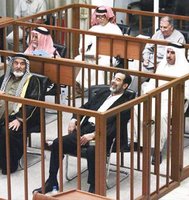
Saddam does Comedy Central
Arab-Jewish Humor:
On another light note, and I think we need some humor these days, the Saudi daily al-Riyadh, claims (July 18) that the Rabbinical Council (Council of Rabbis?) in the occupied West Bank has asked the Israeli government to allow the ‘killing of civilians, including children and women’. The Saudi newspaper claims that the Torah permits such killings during war. The paper reports that some organization or another of Moslem scholars has dutifully, perhaps gleefully, condemned all this.
Hizballah, Sunnis, and Joe Biden:
Mainstream Arab media, mostly state-0wned or controlled, are these days emphasizimg the fact that Hizballah is a Shi'a (Shiite) organization, with close ties to the mullahs in Iran, which is true. And all this time we thought it was just a regional branch of the DAR!
Some claim that it is an outright agent of Iran, which is perhaps an exaggeration. However, before this summer Hizballah was glorified in the Arab press, and always referred to as 'the Lebanese resistance', with no mention of the organization's name or its sectarian affiliations. Or its role as an agent of the mullahs. This new emphasis on sectarianism is probably part of a media war being waged for the minds and hearts of the Arab peoples (mostly Sunnis) between the moderate Arab regimes and the Iranian regime.
Some U.S. politicians have also put in their two cents in encouraging this dangerous sectarian divide. Senator Joe Biden, normally a level-headed man, yesterday openly stressed the need to get the "Sunni Arabs" to oppose Shi'a movements. The problem with this approach, besides the obvious, is that Arab regimes are helpless to do anything beyond issuing statements. They have all been suffering from the deer-in-the-headlights syndrome for years now, and they seem to like it that way.
In a noticeable shift, Sunni fundamentalist writers are now increasingly taking a pro-Hizballah stance, while Sunni secularist writers-there are a few of those- have criticized the foolishness of the kidnapping of the Israeli soldiers.
Some have even strongly criticized the timing of the incident during the peak tourist season in Lebanon. So tell me again, when did you say it was okay to cross the border and kidnap two Israeli teenagers?
Egypt, Again:
Egypt's Mubarak repeated during a press interview that he has never chosen a Vice President because he does not want to impose a VP on the Egyptian people. Come again? What about imposing yourself for twenty five years and counting? Clearly he wants mayhem after he goes- if he intends to go wherever it is that Arab leaders and potentates go when they finally ride into the sunset. Most Arab leaders do not ride into the sunset. They do not ride anywhere- they usually have to be carried out of office, feet first. (I wonder if dyed hair changes color after.....after one is gone, I mean really gone). Most likely Old Husni (78 years) has a sneaky plan that the docile ruling party will choose his son as president.
Cheers
Mohammed
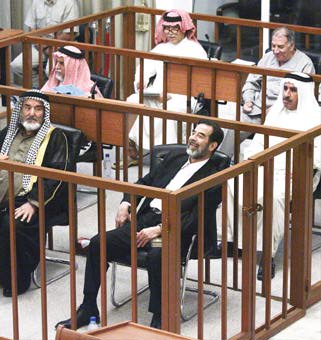
Saddam does Comedy Central
Arab-Jewish Humor:
On another light note, and I think we need some humor these days, the Saudi daily al-Riyadh, claims (July 18) that the Rabbinical Council (Council of Rabbis?) in the occupied West Bank has asked the Israeli government to allow the ‘killing of civilians, including children and women’. The Saudi newspaper claims that the Torah permits such killings during war. The paper reports that some organization or another of Moslem scholars has dutifully, perhaps gleefully, condemned all this.
Hizballah, Sunnis, and Joe Biden:
Mainstream Arab media, mostly state-0wned or controlled, are these days emphasizimg the fact that Hizballah is a Shi'a (Shiite) organization, with close ties to the mullahs in Iran, which is true. And all this time we thought it was just a regional branch of the DAR!
Some claim that it is an outright agent of Iran, which is perhaps an exaggeration. However, before this summer Hizballah was glorified in the Arab press, and always referred to as 'the Lebanese resistance', with no mention of the organization's name or its sectarian affiliations. Or its role as an agent of the mullahs. This new emphasis on sectarianism is probably part of a media war being waged for the minds and hearts of the Arab peoples (mostly Sunnis) between the moderate Arab regimes and the Iranian regime.
Some U.S. politicians have also put in their two cents in encouraging this dangerous sectarian divide. Senator Joe Biden, normally a level-headed man, yesterday openly stressed the need to get the "Sunni Arabs" to oppose Shi'a movements. The problem with this approach, besides the obvious, is that Arab regimes are helpless to do anything beyond issuing statements. They have all been suffering from the deer-in-the-headlights syndrome for years now, and they seem to like it that way.
In a noticeable shift, Sunni fundamentalist writers are now increasingly taking a pro-Hizballah stance, while Sunni secularist writers-there are a few of those- have criticized the foolishness of the kidnapping of the Israeli soldiers.
Some have even strongly criticized the timing of the incident during the peak tourist season in Lebanon. So tell me again, when did you say it was okay to cross the border and kidnap two Israeli teenagers?
Egypt, Again:
Egypt's Mubarak repeated during a press interview that he has never chosen a Vice President because he does not want to impose a VP on the Egyptian people. Come again? What about imposing yourself for twenty five years and counting? Clearly he wants mayhem after he goes- if he intends to go wherever it is that Arab leaders and potentates go when they finally ride into the sunset. Most Arab leaders do not ride into the sunset. They do not ride anywhere- they usually have to be carried out of office, feet first. (I wonder if dyed hair changes color after.....after one is gone, I mean really gone). Most likely Old Husni (78 years) has a sneaky plan that the docile ruling party will choose his son as president.
Cheers
Mohammed
Tuesday, July 18, 2006
Saddam as the new Arab spokesman? His take on the Lebanon War- Beirut Redux
Middle East News Analysis
Saddam Revived:
He is back with a new line!!! But what is his angle?
Saddam is now in the same boat as the United States, Saudi Arabia, Jordan, and the Gulf states- and Israel!! And he speaks for all of the above. Saddam has stated to the Saudi-owned and London-based daily Ashaq Alawsat, through his lawyer, if the lawyer can be believed, that Syria should break up its alliance with Iran, that Iran is the enemy of Arabs and seeks to destroy them. Saddam also said, as qouted in Alarabiya yesterday, that, get this, Tehran is to blame for the current violence in the Middle East. He actually regrets all the violence, much of which he helped unleash over the years, with the Arab regimes cheering in the galleries!
For the first time since the good old days when the Persian Gulf States and Jordan were supporting him wholeheartedly in the war against Iran and in his domestic genocide, in the days just before he turned his unwanted attentions south, Saddam has now found common ground with their governments.
Perhaps he sees himself as a palatable alternative to the elected Iraqi government- he is known to have had a few delusions in the past. But then so had others in his region, and many of them fed his delusions in the past.
Perhaps it is a defense ploy. He is, after all, under the threat of a death sentence and execution by a government composed of his former Shi'a and Kurdish victims.
Lebanon: a flawed strategy?
Events in Lebanon have clearly split the Arab world again. I mean the people on the street, not the Arab governments. To the extent that Al-Arabiya TV (Saudi-owned), which usually has lively forums for comments on news items and the views expressed, yesterday sharply curtailed the forums, in some cases stopping them completely.
There is one serious problem now with the Israeli strategy in Lebanon. It clearly hopes to continue the fighting in order to severely weaken Hizballah and destroy its arsenal, and many Western and Arab governments clearly hope so as well. And, oddly, so does Saddam Hussein now (who would have thunk it). History, of course, tells us that a war cannot be won by airpower and offshore bombing alone. Besides, even a severely weakened Hizballah will probably remain the strongest military force in Lebanon. Unless amnesia sets in and substantial foreign forces are reintroduced, and that would probably be a foolish thing to do.
The problem with the current Israeli strategy is that it cannot last, for it could backfire if the war lasts too long, perhaps beyond the next two weeks. In that case, even supportive Arab governments (Egypt, Jordan, the Gulf States) will be forced by shifting public opinion to change their stands. There are already murmurs of discontent in some of the media, especially in the Gulf. New voices are being raised, some of them Islamist Fundamentalists, not all of them Shi'as, challenging the initial reactions. If we already hear these voices of dissent in a media largely controlled by the Arab regimes and their elite supporters, what is it really like on the streets of Arabia?
Of course, in the end it does not really matter what these states think. It makes no difference where it matters, on the ground. There are three real players in the Middle East now: America, Israel, and Iran, not necessarily in that order. Unfortunately most Arab rulers are usually mere observers to events in their own region- but they can make the appropriate noises.
Cheers
Mohammed
Saddam Revived:
He is back with a new line!!! But what is his angle?
Saddam is now in the same boat as the United States, Saudi Arabia, Jordan, and the Gulf states- and Israel!! And he speaks for all of the above. Saddam has stated to the Saudi-owned and London-based daily Ashaq Alawsat, through his lawyer, if the lawyer can be believed, that Syria should break up its alliance with Iran, that Iran is the enemy of Arabs and seeks to destroy them. Saddam also said, as qouted in Alarabiya yesterday, that, get this, Tehran is to blame for the current violence in the Middle East. He actually regrets all the violence, much of which he helped unleash over the years, with the Arab regimes cheering in the galleries!
For the first time since the good old days when the Persian Gulf States and Jordan were supporting him wholeheartedly in the war against Iran and in his domestic genocide, in the days just before he turned his unwanted attentions south, Saddam has now found common ground with their governments.
Perhaps he sees himself as a palatable alternative to the elected Iraqi government- he is known to have had a few delusions in the past. But then so had others in his region, and many of them fed his delusions in the past.
Perhaps it is a defense ploy. He is, after all, under the threat of a death sentence and execution by a government composed of his former Shi'a and Kurdish victims.
Lebanon: a flawed strategy?
Events in Lebanon have clearly split the Arab world again. I mean the people on the street, not the Arab governments. To the extent that Al-Arabiya TV (Saudi-owned), which usually has lively forums for comments on news items and the views expressed, yesterday sharply curtailed the forums, in some cases stopping them completely.
There is one serious problem now with the Israeli strategy in Lebanon. It clearly hopes to continue the fighting in order to severely weaken Hizballah and destroy its arsenal, and many Western and Arab governments clearly hope so as well. And, oddly, so does Saddam Hussein now (who would have thunk it). History, of course, tells us that a war cannot be won by airpower and offshore bombing alone. Besides, even a severely weakened Hizballah will probably remain the strongest military force in Lebanon. Unless amnesia sets in and substantial foreign forces are reintroduced, and that would probably be a foolish thing to do.
The problem with the current Israeli strategy is that it cannot last, for it could backfire if the war lasts too long, perhaps beyond the next two weeks. In that case, even supportive Arab governments (Egypt, Jordan, the Gulf States) will be forced by shifting public opinion to change their stands. There are already murmurs of discontent in some of the media, especially in the Gulf. New voices are being raised, some of them Islamist Fundamentalists, not all of them Shi'as, challenging the initial reactions. If we already hear these voices of dissent in a media largely controlled by the Arab regimes and their elite supporters, what is it really like on the streets of Arabia?
Of course, in the end it does not really matter what these states think. It makes no difference where it matters, on the ground. There are three real players in the Middle East now: America, Israel, and Iran, not necessarily in that order. Unfortunately most Arab rulers are usually mere observers to events in their own region- but they can make the appropriate noises.
Cheers
Mohammed
Monday, July 17, 2006
Hizballah, Iraq, and The Shia Issue
Middle East News Analysis
Events in Lebanon have replaced Iraq on the front pages of the Middle East. While Arab opinion seemed almost unified about the initial crisis between Hamas and Israel, it is split on the Lebanese crisis and the Hizballah issue.
However, one must remember that the two issues, Iraq and Lebanon, are connected in many Arab minds, especially those in the Persian Gulf region, because both involve a Shi'a movement which could be labeled as either ascendant, assertive or aggressive, depending on one's point of view. The sectarian Shi'a-Sunni issue is not important outside the Gulf region, and most other Arabs, e.g. in the Palestinian areas and North/East Africa look at the broader Arab or Islamic identity of the combatants more than anything else. However, issues involving Shi'as are always considered in light of some domestic status quo in the Gulf region, and the political structure of the region is fragile enough to be affected by regional shifts. The issue of the governance of Iraq, and Iran and its perceived asspirations for hegemony, are also tied in many minds to the domestic sectarian issue (remember President Mubarak's ill-advised comments on the Shia's a few weeks ago?)
The battle around Gaza is looked on as part of an overall Palestinian-Israeli struggle, and many consider that as long as that issue was unresolved then, well, perhaps anything goes on that front. Lebanon has no territorial issues with Israel, not according to the United Nations. As important, at least, is that Lebanon has had another thing going for it: it was becoming prime real estate again to some Arabs, especially Gulf Arab investors. Many have been investing heavily in Lebanon, and it was returning as one favorite vacation spot away from the puritan and dry mores of the Peninsula. They would have been quite happy to let Hizballah have free rein down south, a state within a state, as long as the investment projects, vacation homes, and night spots around Beirut were left alone. The recent violence must have produced, in addition to frustrated and frightened tourists, some disappointed and worried investors. Worst, of course, is the fact that the violence has produced many Lebanese dead and wounded, as well as massive unemployment. It most likely has shattered investor confidence for the foreseeable future.
Hizballah certainly did itself some long-term harm by crossing international borders and kidnapping the Israeli soldiers. Whatever happens now, the previous status quo along the border will be unacceptable to the major powers. This means that at some point after the dust of battle settles Hizballah may lose its military supremacy in the South in one form or another. That has always been one goal of the Israeli strategists.
On the other hand, Hizballah is an indigenous and genuinely popular Lebanese movement. Unlike the PLO of the 1980s it cannot be uprooted from its Shi'a base in southern Lebanon and Beirut. In fact, removing its militias from the south will push them closer to the capital, and that prospect makes the other Lebanese warlords quite nervous because it will threaten to undo the balance of political power that has existed since the end of the civil war. I suspect that many influential politicians would have preferred for Hizballah to remain far away in the south, so long as it did not provoke the Israelis to the serious extent that it has recently.
Still, if Secretary Rice goes to the Middle East, then the region expects some results. The Arabs on the street, and many Arabs off-the-street- i.e. those who should know better- are schizophrenic when it comes to the United States. On the one hand many think it is helplessly stuck and being bloodied in Iraq, and Afghanistan, yet on the other hand, they think it has the power to stop any war in the region. If the Secretary goes to the region soon, she will face the challenge of producing at least a cease fire. Perhaps not too soon, but at some point before returning to Washington.
As for the President's open-mike comment to Tony Yea-Blair in St Petersburg, so what, as Madeline Albright wisely said yesterday: IT happens.
Cheers
Mohammed
Events in Lebanon have replaced Iraq on the front pages of the Middle East. While Arab opinion seemed almost unified about the initial crisis between Hamas and Israel, it is split on the Lebanese crisis and the Hizballah issue.
However, one must remember that the two issues, Iraq and Lebanon, are connected in many Arab minds, especially those in the Persian Gulf region, because both involve a Shi'a movement which could be labeled as either ascendant, assertive or aggressive, depending on one's point of view. The sectarian Shi'a-Sunni issue is not important outside the Gulf region, and most other Arabs, e.g. in the Palestinian areas and North/East Africa look at the broader Arab or Islamic identity of the combatants more than anything else. However, issues involving Shi'as are always considered in light of some domestic status quo in the Gulf region, and the political structure of the region is fragile enough to be affected by regional shifts. The issue of the governance of Iraq, and Iran and its perceived asspirations for hegemony, are also tied in many minds to the domestic sectarian issue (remember President Mubarak's ill-advised comments on the Shia's a few weeks ago?)
The battle around Gaza is looked on as part of an overall Palestinian-Israeli struggle, and many consider that as long as that issue was unresolved then, well, perhaps anything goes on that front. Lebanon has no territorial issues with Israel, not according to the United Nations. As important, at least, is that Lebanon has had another thing going for it: it was becoming prime real estate again to some Arabs, especially Gulf Arab investors. Many have been investing heavily in Lebanon, and it was returning as one favorite vacation spot away from the puritan and dry mores of the Peninsula. They would have been quite happy to let Hizballah have free rein down south, a state within a state, as long as the investment projects, vacation homes, and night spots around Beirut were left alone. The recent violence must have produced, in addition to frustrated and frightened tourists, some disappointed and worried investors. Worst, of course, is the fact that the violence has produced many Lebanese dead and wounded, as well as massive unemployment. It most likely has shattered investor confidence for the foreseeable future.
Hizballah certainly did itself some long-term harm by crossing international borders and kidnapping the Israeli soldiers. Whatever happens now, the previous status quo along the border will be unacceptable to the major powers. This means that at some point after the dust of battle settles Hizballah may lose its military supremacy in the South in one form or another. That has always been one goal of the Israeli strategists.
On the other hand, Hizballah is an indigenous and genuinely popular Lebanese movement. Unlike the PLO of the 1980s it cannot be uprooted from its Shi'a base in southern Lebanon and Beirut. In fact, removing its militias from the south will push them closer to the capital, and that prospect makes the other Lebanese warlords quite nervous because it will threaten to undo the balance of political power that has existed since the end of the civil war. I suspect that many influential politicians would have preferred for Hizballah to remain far away in the south, so long as it did not provoke the Israelis to the serious extent that it has recently.
Still, if Secretary Rice goes to the Middle East, then the region expects some results. The Arabs on the street, and many Arabs off-the-street- i.e. those who should know better- are schizophrenic when it comes to the United States. On the one hand many think it is helplessly stuck and being bloodied in Iraq, and Afghanistan, yet on the other hand, they think it has the power to stop any war in the region. If the Secretary goes to the region soon, she will face the challenge of producing at least a cease fire. Perhaps not too soon, but at some point before returning to Washington.
As for the President's open-mike comment to Tony Yea-Blair in St Petersburg, so what, as Madeline Albright wisely said yesterday: IT happens.
Cheers
Mohammed
Saturday, June 10, 2006
Light in the Iraqi Tunnel, World Cup Sex Trade, Persian Gulf Politics
News and Analysis
In Iraq, it looks like a decisive shift is in progress now, and not only because of the death of Zarqawi or the completion of the cabinet. Hints of this shift are also being reflected in both Iraqi, Arab, and World media coverage of recent days. It has been barely perceptible at first, but I believe that it is gathering momentum. It hints at a move within Iraq farther away from the terrorists who have plagued the Western and Central regions in the past three years. Even some of the Arab media that have in the past been sympathetic to these groups seem to be edging away now, some of them seemingly dejected at the turn of events. One can read it in the slightly changed nuances of their reporting on the conflict. Is this the beginning of an irreversible shift? It is quite likely that the terror/insurgency campaign has crested and has nowhere to go but downhill. It looks like they could not manage to get their own Tet offensive underway.
Jordan is trying hard to get some credit for the success of the operation in Baghdad that killed al-Zarqawi. This seems to be part of a recent media blitz under way now by Jordan to stress its role in the war on terrorism. Unknown and unnamed Jordanian sources have been quick to try and get some credit for the demise of al-Zarqawi, by contacting major U.S. media outlets with claims that Jordanian intelligence operations were somehow crucial in the operation that finished off the terrorist chief. This is done probably partly to impress the U.S Congress- money, money, money- at this important time and partly to show that the government has now avenged the bombings in Amman. Maybe, but success has many fathers while failure is a bastard.
The World Cup final games have started in Germany. A report in the today's New York Times claims that: ‘It is estimated that more than 40,000 women and children will be imported to Germany during the month-long competition to provide commercial sex in the "mega-brothels," "quickie shacks," and other legalized venues and vast underground networks that exist in Germany’.
In Kuwait, according to a clever and perhaps politically-motivated report in al-Watan (owned by members of the ruling family), a statement by Iraq’s Ayatollah Ali al-Sistani forbidding the buying and selling of votes during elections is being widely discussed during this country's campaign for the elections at the end of June. Given the sectarian undercurrents, the local effects of this report should be mixed at best. According to the local media, voters are being offered ever more expensive presents, more cash, and even travel tickets to vote for certain candidates. Some estimates have put the price of a vote at thousands of US dollars, depending on how close the outcome looks in each district. Opposition groups and media have claimed that pro-government agents have withdrawn tens of millions of funds from the Central Bank in order to finance certain candidates and to buy votes. In recent years, opposition groups have cited rampant corruption in foreign investments, oil contracts, and exorbitant commissions extracted by local potentates for huge, and perhaps unnecessary, military purchases.
Persian Gulf stock markets had mixed results in the past week (ended Thursday). It still looks like the markets are moving within a range that is now wider than two weeks ago. There have been complaints by investors and market analysts about the difficulty of replacing the boards and the managing directors of listed companies.
The Gulf region is notorious for the longevity of its company leadership, as well as for the longevity of high public officials. Which in a perverse way makes some sense: after all, kings, emirs and potentates have no term limits either. It is common for an undersecretary to remain thirty years in office, while the normal tenure in the west, especially the United States, is probably less than four years. Some ministers in the Gulf remain in the job for their whole adult life, especially those that are restricted to members of the ruling families such as Foreign Affairs, Interior (Security), and Defense. There are ministers who have held their jobs for about forty years- I wonder how big a watch they get at retirement. These are no longer considered ministries, they are almost personal feudal fiefdoms.
Now Somalia seems poised to repeat the old Afghan experience. A new fundamentalist group have taken over the capital from the war Emirs, and are imposing strict Islamic rule. In Mogadishu, an Islamic Taliban-style fundamentalist groups that have taken over call themselves Mahakim al-Shari'a, the ‘Shari’a Courts’ regime. They have closed cinema theaters and banned World Cup soccer games. What? And not be able to see the Somali team trounce the Brazilians in the final? The good news: they only control the capital, so far.
Cheers
Mohammed
In Iraq, it looks like a decisive shift is in progress now, and not only because of the death of Zarqawi or the completion of the cabinet. Hints of this shift are also being reflected in both Iraqi, Arab, and World media coverage of recent days. It has been barely perceptible at first, but I believe that it is gathering momentum. It hints at a move within Iraq farther away from the terrorists who have plagued the Western and Central regions in the past three years. Even some of the Arab media that have in the past been sympathetic to these groups seem to be edging away now, some of them seemingly dejected at the turn of events. One can read it in the slightly changed nuances of their reporting on the conflict. Is this the beginning of an irreversible shift? It is quite likely that the terror/insurgency campaign has crested and has nowhere to go but downhill. It looks like they could not manage to get their own Tet offensive underway.
Jordan is trying hard to get some credit for the success of the operation in Baghdad that killed al-Zarqawi. This seems to be part of a recent media blitz under way now by Jordan to stress its role in the war on terrorism. Unknown and unnamed Jordanian sources have been quick to try and get some credit for the demise of al-Zarqawi, by contacting major U.S. media outlets with claims that Jordanian intelligence operations were somehow crucial in the operation that finished off the terrorist chief. This is done probably partly to impress the U.S Congress- money, money, money- at this important time and partly to show that the government has now avenged the bombings in Amman. Maybe, but success has many fathers while failure is a bastard.
The World Cup final games have started in Germany. A report in the today's New York Times claims that: ‘It is estimated that more than 40,000 women and children will be imported to Germany during the month-long competition to provide commercial sex in the "mega-brothels," "quickie shacks," and other legalized venues and vast underground networks that exist in Germany’.
In Kuwait, according to a clever and perhaps politically-motivated report in al-Watan (owned by members of the ruling family), a statement by Iraq’s Ayatollah Ali al-Sistani forbidding the buying and selling of votes during elections is being widely discussed during this country's campaign for the elections at the end of June. Given the sectarian undercurrents, the local effects of this report should be mixed at best. According to the local media, voters are being offered ever more expensive presents, more cash, and even travel tickets to vote for certain candidates. Some estimates have put the price of a vote at thousands of US dollars, depending on how close the outcome looks in each district. Opposition groups and media have claimed that pro-government agents have withdrawn tens of millions of funds from the Central Bank in order to finance certain candidates and to buy votes. In recent years, opposition groups have cited rampant corruption in foreign investments, oil contracts, and exorbitant commissions extracted by local potentates for huge, and perhaps unnecessary, military purchases.
Persian Gulf stock markets had mixed results in the past week (ended Thursday). It still looks like the markets are moving within a range that is now wider than two weeks ago. There have been complaints by investors and market analysts about the difficulty of replacing the boards and the managing directors of listed companies.
The Gulf region is notorious for the longevity of its company leadership, as well as for the longevity of high public officials. Which in a perverse way makes some sense: after all, kings, emirs and potentates have no term limits either. It is common for an undersecretary to remain thirty years in office, while the normal tenure in the west, especially the United States, is probably less than four years. Some ministers in the Gulf remain in the job for their whole adult life, especially those that are restricted to members of the ruling families such as Foreign Affairs, Interior (Security), and Defense. There are ministers who have held their jobs for about forty years- I wonder how big a watch they get at retirement. These are no longer considered ministries, they are almost personal feudal fiefdoms.
Now Somalia seems poised to repeat the old Afghan experience. A new fundamentalist group have taken over the capital from the war Emirs, and are imposing strict Islamic rule. In Mogadishu, an Islamic Taliban-style fundamentalist groups that have taken over call themselves Mahakim al-Shari'a, the ‘Shari’a Courts’ regime. They have closed cinema theaters and banned World Cup soccer games. What? And not be able to see the Somali team trounce the Brazilians in the final? The good news: they only control the capital, so far.
Cheers
Mohammed
Thursday, June 08, 2006
Cool al-Zarqawi, Bin Laden in the Northwest Frontier, Iraqi Cabinet Stabilized
News Analysis
Al-Zarqawi at room temperature. ( Disclaimer: I plagiarized this cute term from a famous and controversial radio show host). They say he was killed during a meeting, which might mean that several other leaders of al-Qaida were also killed with him. After all, a leader usually meets with his top assistants and allies. Some Arab media also claim that one of his three wives was at the same house and was killed with him (I guess he was not too busy, or perhaps his jihad did not consume that much energy).
According to aljazeera TV, a spokesman for an organization called ‘The Arab Committee for Human Rights’ has complained that Americans showing pictures of Zarqawi in death is against the Third Geneva Convention on human rights. He claimed the Jordanian Zarqawi was a prisoner of war. I thought he looked like a dead outlaw, although he did not look as pretty as, say, Pretty Boy Floyd, or even Dillinger for that matter. I am not sure what the 3rd convention is. I certainly don’t know what the hell this Arab Committee for Human Rights is either. Never heard of them before, usually it is a human rights Society or Association. A Committee means a body composed of a few people, probably self-appointed. Besides I didn’t know we had enough human rights in the Arab World to require a gaggle of committeemen.
Most Iraqi street reaction, and Iraqi comments on the Internet, has been joyful in reaction to the death of this desperado. Egyptian comments have also reflected relief. Iraq has a full cabinet now. A Sunni got the Defense Ministry, and Shi’as got the Interior and National Security.
Arab reports have been talking of a shift in Afghanistan, where gruesome and indiscriminate Salafi-style killings are being slowly introduced by Taliban supporters. Violence in Afghanistan, especially in the area near the Pakistani border has increased. Meanwhile, friction has increased between Pakistani and Afghan governments over various issues, including where Bin Laden is holed up. For a while, Pakistani lobbyists in the United States had pushed the improbable idea that he was in Iran. Now the Afghans have burst that balloon for good by confirming that Bin Laden is in Pakistan- and this is certainly a more credible assertion. The idea of Osama leaving his base of supporters and handing his security, and his network, to those he considers the heretic Mullahs in Iran was always highly suspect.
Looks like things have calmed down for now on the US-Iran front. That should last only for a few weeks. Perhaps until after the final game of the World Cup in Germany. It would be interesting, and highly dramatic, perhaps even comic, if the United States and Iran reach the final game, the World Super Bowl, with G W Bush and AhmadiNejad facing each other in attendance, super cheerleaders for Das Gunfight at Das Okay Korral, nicht war? But, dommage, it is not likely that either team will get to the finals. Maybe the second round would be the best hope for the face-off.
Cheers
Mohammed
Al-Zarqawi at room temperature. ( Disclaimer: I plagiarized this cute term from a famous and controversial radio show host). They say he was killed during a meeting, which might mean that several other leaders of al-Qaida were also killed with him. After all, a leader usually meets with his top assistants and allies. Some Arab media also claim that one of his three wives was at the same house and was killed with him (I guess he was not too busy, or perhaps his jihad did not consume that much energy).
According to aljazeera TV, a spokesman for an organization called ‘The Arab Committee for Human Rights’ has complained that Americans showing pictures of Zarqawi in death is against the Third Geneva Convention on human rights. He claimed the Jordanian Zarqawi was a prisoner of war. I thought he looked like a dead outlaw, although he did not look as pretty as, say, Pretty Boy Floyd, or even Dillinger for that matter. I am not sure what the 3rd convention is. I certainly don’t know what the hell this Arab Committee for Human Rights is either. Never heard of them before, usually it is a human rights Society or Association. A Committee means a body composed of a few people, probably self-appointed. Besides I didn’t know we had enough human rights in the Arab World to require a gaggle of committeemen.
Most Iraqi street reaction, and Iraqi comments on the Internet, has been joyful in reaction to the death of this desperado. Egyptian comments have also reflected relief. Iraq has a full cabinet now. A Sunni got the Defense Ministry, and Shi’as got the Interior and National Security.
Arab reports have been talking of a shift in Afghanistan, where gruesome and indiscriminate Salafi-style killings are being slowly introduced by Taliban supporters. Violence in Afghanistan, especially in the area near the Pakistani border has increased. Meanwhile, friction has increased between Pakistani and Afghan governments over various issues, including where Bin Laden is holed up. For a while, Pakistani lobbyists in the United States had pushed the improbable idea that he was in Iran. Now the Afghans have burst that balloon for good by confirming that Bin Laden is in Pakistan- and this is certainly a more credible assertion. The idea of Osama leaving his base of supporters and handing his security, and his network, to those he considers the heretic Mullahs in Iran was always highly suspect.
Looks like things have calmed down for now on the US-Iran front. That should last only for a few weeks. Perhaps until after the final game of the World Cup in Germany. It would be interesting, and highly dramatic, perhaps even comic, if the United States and Iran reach the final game, the World Super Bowl, with G W Bush and AhmadiNejad facing each other in attendance, super cheerleaders for Das Gunfight at Das Okay Korral, nicht war? But, dommage, it is not likely that either team will get to the finals. Maybe the second round would be the best hope for the face-off.
Cheers
Mohammed
Thursday, June 01, 2006
Iran's Nuclear Game: Why The Mullahs Will Not Bite
News Analysis
They say it is a triumph for Condoleeza Rice's diplomacy, to get all permanent members of the Security Council in Vienna behind a unified position toward Iran. It is.
The Ayatollahs, and Mr. Ahmadinejad, however, are not likely to be impressed with the offer, not publicly. Not enough to accept the broad terms, which are not all known, although the most important of them are known.
North Korea was encouraged in the 1990's by the bait of foreign aid, and by the delusions of one sitting US president and one former (Democratic) US president. North Korea needed the carrot, so it pretended to accept the terms. Then it cheated. What is shocking is not that it cheated: what is shocking is that some people were shocked later to find out that it had cheated.
How is Iran different?
Iran, although mismanaged by the theocracy, and beset by the corruption that plagues all major oil producers, is not in the same desperate economic situation. It is relatively rich, especially in oil that is now priced at $ 68-75 a barrel, and may well go up much higher before the end of this year. It is even richer in natural gas, which may have reached its lowest price and is poised to go up.
We must also remember the noisy clamor in Europe for lifting the economic sanctions against Saddam, who was a serial invader who had used WMD against the Iranians, the Kurds, and the Shi'as. And the Strait of Hormuz is one of the most vulnerable waterways and it is straddled by Iran.
Then there is the question of the audience for whom these people perform. Kim Jung Il performed for the Korean Peninsula. Iran's leaders perform for several audiences: The Iranian people, all Middle Eastern people, all Moslems, and the World at large- not necessarily always in that order. That makes it almost impossible for them to back down now. Having tried to show a hardline defiance toward the United States, to out-revolutionary others revolutionaries, they cannot turn tail now.
Besides, the Mullahs have two aces up their sleeves:
The major powers agree with the US at this stage of the Iran situation, but will they agree on follow-up steps? The Iranians have guessed that some of them will not.
They also perceive the United States as militarily bogged down in Iraq, and to a lesser degree Afghanistan. That it does not have the will, and perhaps the resources, for another military confrontation. I believe this is an extremely risky bet for them, for American resolve has been doubted and challenged in the past, and most of the challengers have beeen unpleasantly surprised- from the potentates of Barbay Coast to Baghdad. Still, when the time comes, if it comes, it might be very hard to make the case that the 'national interests' of the United States are directly threatened.
The road to Tehran is not nearly as open as the road to Baghdad, it is a vast rough landscape. Besides, if 150,00 troops were not enough to pacify Western Iraq, how much will be needed to pacify a country three times as large as Iraq? Clearly, both governments are bluffing to some degree in this game, but now I am not sure which one is bluffing more.
Most Middle East observers (those from the Middle East) seem to believe that an Iranian bomb is inevitable, even if the degree of advance in developing one may have been exaggerated for now. Which is unfortunate, for that country, and the Middle East, does not need nuclear weapons.
Cheers
Mohammed
They say it is a triumph for Condoleeza Rice's diplomacy, to get all permanent members of the Security Council in Vienna behind a unified position toward Iran. It is.
The Ayatollahs, and Mr. Ahmadinejad, however, are not likely to be impressed with the offer, not publicly. Not enough to accept the broad terms, which are not all known, although the most important of them are known.
North Korea was encouraged in the 1990's by the bait of foreign aid, and by the delusions of one sitting US president and one former (Democratic) US president. North Korea needed the carrot, so it pretended to accept the terms. Then it cheated. What is shocking is not that it cheated: what is shocking is that some people were shocked later to find out that it had cheated.
How is Iran different?
Iran, although mismanaged by the theocracy, and beset by the corruption that plagues all major oil producers, is not in the same desperate economic situation. It is relatively rich, especially in oil that is now priced at $ 68-75 a barrel, and may well go up much higher before the end of this year. It is even richer in natural gas, which may have reached its lowest price and is poised to go up.
We must also remember the noisy clamor in Europe for lifting the economic sanctions against Saddam, who was a serial invader who had used WMD against the Iranians, the Kurds, and the Shi'as. And the Strait of Hormuz is one of the most vulnerable waterways and it is straddled by Iran.
Then there is the question of the audience for whom these people perform. Kim Jung Il performed for the Korean Peninsula. Iran's leaders perform for several audiences: The Iranian people, all Middle Eastern people, all Moslems, and the World at large- not necessarily always in that order. That makes it almost impossible for them to back down now. Having tried to show a hardline defiance toward the United States, to out-revolutionary others revolutionaries, they cannot turn tail now.
Besides, the Mullahs have two aces up their sleeves:
The major powers agree with the US at this stage of the Iran situation, but will they agree on follow-up steps? The Iranians have guessed that some of them will not.
They also perceive the United States as militarily bogged down in Iraq, and to a lesser degree Afghanistan. That it does not have the will, and perhaps the resources, for another military confrontation. I believe this is an extremely risky bet for them, for American resolve has been doubted and challenged in the past, and most of the challengers have beeen unpleasantly surprised- from the potentates of Barbay Coast to Baghdad. Still, when the time comes, if it comes, it might be very hard to make the case that the 'national interests' of the United States are directly threatened.
The road to Tehran is not nearly as open as the road to Baghdad, it is a vast rough landscape. Besides, if 150,00 troops were not enough to pacify Western Iraq, how much will be needed to pacify a country three times as large as Iraq? Clearly, both governments are bluffing to some degree in this game, but now I am not sure which one is bluffing more.
Most Middle East observers (those from the Middle East) seem to believe that an Iranian bomb is inevitable, even if the degree of advance in developing one may have been exaggerated for now. Which is unfortunate, for that country, and the Middle East, does not need nuclear weapons.
Cheers
Mohammed
Iraqi Blood and Money, Kuwait University Wears The Burqa’a, Saudi Softening
Middle East Notes
In Iraq, the Prime Minister plans to submit candidates for the last positions in the cabinet next Sunday. Sunday? I guess he has never seen that old Melina Mercuri film.
Some violence has erupted in Basrah in the south, but it is among the militias…no suicide homicides against civilians there. The government declared a state of emergency in the city for a month. The PM and President plan a visit, presumably in order to try mediation .
Press reports claim that an early item on the new Iraqi parliament’s agenda is raising the salaries and benefits of its members. Now why does that sound so familiar here where I am sitting right now in the U.S. of A. I wonder what they would ask for if they hear about the $400+ million that the clubby board of Exxon-Mobil gave its departing CEO recently.
German media report that three German women have been arrested while planning terrorist activities in Iraq and Pakistan. Apparently the women are married to Islamic fundamentalists. The report claims that security agents were able to track the women from Internet chat rooms that they frequented. The reports claim that two of the women were planning on taking their children along.
Jordan has not announced uncovering any new plots, intercepting any new arms shipments, or any new arrests for a few days now. However, the king was in Washington, again. Didn’t I see him only two weeks ago with the President? Well, this reminds me of the late Arafat and Bill Clinton, and how they got together almost every month at the White House to solve the world’s pressing problems. And, incidentally, perhaps talk about money. Something is going on.
In Kuwait, the Dean of the Shari’a College (Islamic Theology) at Kuwait University has issued a Fatwa (a religious edict) that a husband has the right to impose the candidate of his choice on his wife and that she would have to vote for that candidate- otherwise he can divorce her. That means the husband gets to choose who or what his wife votes for. It is true that the said Dean was appointed in his position by the government, as are the religious shaikhs appointed by the same government- they are both state bureaucrats. But since when do academic types who are not even ordained or appointed religious men issue fatwas?
It is truly a country of batteikh (watermelon for most of you foreign types), sort of like a moral wild wild west.
A high Saudi royal and religious adviser has said it is proper for a qualified learned woman to give opinion and fatwas. He said that in ancient Islamic history, there were women who gave fatwas and even taught men about the faith. This is a first.
Wait, there is more, and better, news: he also said it is not necessarily bad that there are Internet sites that get men and women together for marriage.
Cheers
Mohammed
In Iraq, the Prime Minister plans to submit candidates for the last positions in the cabinet next Sunday. Sunday? I guess he has never seen that old Melina Mercuri film.
Some violence has erupted in Basrah in the south, but it is among the militias…no suicide homicides against civilians there. The government declared a state of emergency in the city for a month. The PM and President plan a visit, presumably in order to try mediation .
Press reports claim that an early item on the new Iraqi parliament’s agenda is raising the salaries and benefits of its members. Now why does that sound so familiar here where I am sitting right now in the U.S. of A. I wonder what they would ask for if they hear about the $400+ million that the clubby board of Exxon-Mobil gave its departing CEO recently.
German media report that three German women have been arrested while planning terrorist activities in Iraq and Pakistan. Apparently the women are married to Islamic fundamentalists. The report claims that security agents were able to track the women from Internet chat rooms that they frequented. The reports claim that two of the women were planning on taking their children along.
Jordan has not announced uncovering any new plots, intercepting any new arms shipments, or any new arrests for a few days now. However, the king was in Washington, again. Didn’t I see him only two weeks ago with the President? Well, this reminds me of the late Arafat and Bill Clinton, and how they got together almost every month at the White House to solve the world’s pressing problems. And, incidentally, perhaps talk about money. Something is going on.
In Kuwait, the Dean of the Shari’a College (Islamic Theology) at Kuwait University has issued a Fatwa (a religious edict) that a husband has the right to impose the candidate of his choice on his wife and that she would have to vote for that candidate- otherwise he can divorce her. That means the husband gets to choose who or what his wife votes for. It is true that the said Dean was appointed in his position by the government, as are the religious shaikhs appointed by the same government- they are both state bureaucrats. But since when do academic types who are not even ordained or appointed religious men issue fatwas?
It is truly a country of batteikh (watermelon for most of you foreign types), sort of like a moral wild wild west.
A high Saudi royal and religious adviser has said it is proper for a qualified learned woman to give opinion and fatwas. He said that in ancient Islamic history, there were women who gave fatwas and even taught men about the faith. This is a first.
Wait, there is more, and better, news: he also said it is not necessarily bad that there are Internet sites that get men and women together for marriage.
Cheers
Mohammed
Sunday, May 28, 2006
Gulf Markets in Rehab, Naked Witches of Arabia, and Algerian Democracy

Middle East Notes
Algeria has a new Prime Minister. Mr. Bel-Khadim has replaced Mr. O’Yehya (no, he ain’t Irish). A report in al-Hayat from Algeria indicates that the new Prime Minister has a new agenda: so far so good, a new PM should have a new agenda. The main items on this new agenda, according to press reports, are to allow the president of the country to run for three terms instead of two, and to extend each term to 7 years instead of the current 5 years. That makes sense: that way Algeria’s president has a better chance of dying in office, which puts him at par with all other Arab leaders (perhaps with the exception of Iraq). Sounds almost like an attempt at regional coordination of dictatorial terms, of the kind that in the past might have been proposed by the Arab Foreign Ministers Council. In any case, the Algerian move is one strand in an emerging trend of the expected backtracking by Arab regimes on promises of democracy. This proves that a hog with a lot of make-up (macquillage?) is still a hog.
Al-Arabiya TV reports that Saudi religious sheikhs are upset, really pissed, about news that a professor from Nottingham University in Britain has proved that the egg came before the chicken. Other UK professors have expressed support. This is purported to support the theory of evolution, and to deny the existence of the creator deity. However, an official from the Saudi Ministry of Justice, to his credit, said that this does not necessarily deny the existence of a deity. Is everyone else as confused about this, or is it just I?
Since we are in the neighborhood: a major Saudi daily newspaper (Okaz) reported that a group of the special Islamic Morality Police (Muttawa'een) raided a “nest of witchcraft and magic in Medinah”, only to be startled when confronted with a completely naked African witch. They claimed that she disappeared as suddenly, and that their search for her was not successful. A neighbor claimed that a naked African witch crashed into his apartment through the roof, prompting him and his family to escape. She was eventually arrested, still naked. Twenty other women were apprehended, and manuals and videotapes on witchcraft were confiscated. There are no reports whether the latter included copies of Witchcraft for Dummies. At least one person will lose her head: the practice of witchcraft is punishable by beheading. Most likely she will be fully clothed on the fateful day.
Many Saudi men now resort to mass weddings to reduce the soaring cost of.....weddings. The economies of scale, you know. This is especially important because of the losses incurred by many middle class Saudis in the recent stock market crash in the Kingdom. That still leaves the issue of the biggest part of the cost: the dowry that the groom must pay. The network reports that one recent wedding in Ahsaa’ province included 1400 couples. That is one party that would be easy to crash, but would you want to?
The Saudi market crash has apparently led to a lot of soul searching- so far no news of any jumps off high buildings- and this in itself indicates that the effects of the crash are deeply felt within the Saudi society, perhaps well beyond the realm of finance and economics. There have been several conferences, seminars and symposiums about the issue- as well as polls and media surveys. No reports yet whether psychotherapy and rehabilitation activities have picked up.
Stock markets in Arab region have remained stagnant. In the Persian Gulf, movements of the main indices have been uninspiring, although both markets in the United Arab Emirates recorded modest increases. In Kuwait press reports say that the Kuwait Investment Authority will dump more money in the market- a figure of another KD 100 million was mentioned. One newspaper reported that the KIA will be equitable and just when it purchases shares. Perhaps it is not too much to hope that it will also be sensible and professional in placing public funds. But then again, equitable is not a normal criterion for placing investments. More like Prozac than therapy, but will it affect the market?
Speaking of public money and spending: The snap Kuwait election for the assembly is set for the end of June, and there are many rumors and stories in the local press. I wonder if votes are still as actively bought and sold in some districts, and how much they are now. The authorities might want to look into securetization of traded votes- that might diversify the market and allow better risk management. The daily al-Qabas reports that several disgruntled members of one branch of the ruling family are considering a run. Go for it.
Cheers
Mohammed
Friday, May 26, 2006
Why Some Western Leftists Idolize Arab Fascists and Islamic Fundamentalists

MIDDLE EAST NOTES
I recently came across an interesting article by Tariq Ali titled “Mid-Point in The Middle East?" originally published in the New Left Review.
As is his usual style, it deals broadly with various corners of the Middle East. It makes for interesting, and often educational, reading. But I have a few issues with some aspects of the article, especially regarding Iraq.
The 'resistance' in Iraq is not a national liberation movement a la the 1960s. It is actually more a 'Sunni Sectarian' movement which seeks a return to the authoritarian minority system that was set up by the British in 1921, whereby at first the Turkish-groomed grandees of the Baghdad area then, after 1958, the military juntas of the Tikrit-Samarra-Falluja region ruled the country.
I know, I can hear Tariq Ali saying: so what, the Fidelistas were a small minority in the mid-1950s, as were the Bolsheviks throughout 1917. The difference is that those two movements did not represent narrow and chauvenistic ethnic and sectarian interests- they could expand to encompass a majority. Whether they did is debatable, because I have seen no voting data about that.
The British, in my view, were obliged to enter the fray in 2003 once it was clear that the die was cast. After all they had to go in to finish the job they had botched earlier when they imported and installed Faisal I on the throne and, according to Gertrude Bell (from the horse's mouth) favored the minority Sunnis of the central region to rule over the Shi'as and the Kurds. Perhaps they felt, being British and proper, that it was worthwhile to take a shot at making another mistake in order to correct an earlier one.
Still, one must notice that this recent intervention, or adventure, in iraq has in fact changed the situation in the Middle East- it has mixed and reshuffled the cards, something that was needed in that stagnant region. After all, there are riots in Cairo now!! And the Egyptian people are normally among the most complacent and most patient sufferers in the world. Even the hereditary oil potentates of the Persian Gulf and their oligarchies are mouthing phrases about elections and reform. True, the few open elections in the Middle East have resulted in a 'rightward' move toward Islamic fundamentalism that is unfortunate. But then again, perhaps that has been the only realistic alternative to a corrupt 'center'. That corrupt center- and I use center here cautiously only to distinguish it from the religious or fundamentalist 'right'- includes the Arab regimes.
True, as Tariq Ali claims, the mainstream Shi'as in Iraq threw in their lot, at least tacitly, with the occupation, in the sense that hey did not resist it. Not that they had much of a choice: you could not expect them to actually fight for Saddam and his Ba’ath regime now did you? That would be almost like expecting German or Polish Jews to fight the advancing American or Soviet armies in 1945, and complain if they declined the honor. We must also remember that the Shi'as did rebel and resist that earlier occupation of Iraq after World War I while the others collaborated with the occupiers- those others were handed the power and the Shi'as paid a heavy political price for it over many decades.
For many years, those who are now leading the insurgency/terrorism in Iraq were quite happy to throw in their lot openly with the West, and with the absolute monarchies of the region, when they faced the human wave assaults and the fall of the Fao Peninsula during the Iran-Iraq of the 1980s, when their own power was threatened. It is foolish for some European dreamers to equate these Ba’athists and Salafi bombers to the Viet Cong of the 1960s. The Ba’ath is a fascist party that was inspired by the Nazis and Fascists of Europe, and it later adopted some of the slogans of the European Left even while it was slaughtering the Communists in Iraq. To claim that “The Anglo-American armies need to be driven out of the country, bag and baggage, for Iraq to have any future” is to turn a blind eye to the sectarian disaster that could erupt if that withdrawal is precipitous and immediate.
The rule of thumb, as far as judging various regimes around the world goes, should be simple: do I, my lucky free self, moi, want to live under such a regime? Otherwise I should not promote it for others- they might deserve better even if they are Third-World types who might have known no better.
These retro-dreamers in Europe and the United States should remember that the Viet Cong never had a known policy of systematically blowing up their own civilian populations, not even in the name of national liberation.
Cheers
Mohammed
Thursday, May 25, 2006
Siege of Jordan, Persian Gulf Markets, Egypt’s Gamal Comes to Washington
Middle East Analysis
Interesting things are happening in Jordan. Apparently Jordan’s government is embarked on a media blitz these days, with accusations of plots flying around. The suspects are the usual ones: Hamas, Syria, Iran. Some witty Arab Internet comments now expect that Venezuela, Cuba and North Korea might be added to the list of Jordanian suspects soon.
Now the Speaker of Jordan’s parliament Mr. al-Majali, he is also a former head of Jordanian Security Services, has accused the Iranian regime of aiming to destabilize Jordan. He said that Iran is a threat to Jordan. Most Arab Internet comments seem to say that if Iran is a threat to some countries, it probably has larger fish to fry than Jordan. Some see the Jordanian stance as part of a concerted Western effort against the Iranian regime.
It is possible that Jordan is legitimately worried about some sort of encirclement by proxy by the Iranian theocrats- with Iran-friendly Iraq, Iran-friendly Syria, and now an Iran-friendly Palestinian government all around it. Things look that way although it is hardly aimed directly at Jordan, which has no significant strategic importance.
Speaking of the Speaker, Jordanian security services have been notorious in the past because of rumors that they were exporting mercenary interrogators under the guise of ‘security trainers’ to some of the smaller Persian Gulf states in the 1980s and 1990s. Apparently it is hard in a small tribal society to ask a native interrogator to interrogate his neighbor severely. It is easier for inquisitors imported from outside to engage in certain activities in a small society- things like pulling out fingernails or inserting electrodes in extremely sensitive parts of the body. It is not clear now if Jordanian security experts are still being engaged to perform these interesting activities in the Gulf.
In Bahrain, the main political groupings are grumbling about the honesty and transparency of delayed municipal and legislative elections. The complaints are mainly about not setting firm dates for the promised elections and suspicions about proposed electronic voting, presumably because the government can manipulate the results, whenever these elections are held. Half of the Bahrain legislature is non-elected but appointed by the King.
Gulf stock markets seem to be moving within a narrow range. Some traders are happy that the serious slide has apparently stopped for now. Officials certainly have done their best to talk up shares prices, with promises of new plans that would implicitly shore up demand. In some cases, the UAE, restrictions were imposed on establishing new public share-holding companies.
In Qatar, the cabinet amended existing laws to allow listed companies to buy back their shares. The Qatari market has lost about 44% of market capitalization since peaking earlier this year. Investor comments were skeptic whether many companies will actually buy back their own shares. Company profits in the Gulf have suffered noticeably during the first quarter of the year as well, because a large number of listed companies are either in the financial sector or depend on investment (non-operational) income for part of their earnings.
In Iraq, one of the country’s Vice Presidents, the Sunni Arab one, extolled the virtues of ‘legitimate’ resistance against the US forces and against the government of which he is a part. His statement was an excruciating example of the old Ba’athist and pan-Arabist double speak of the past decades. He did, however, exclude al-Qaida in Iraq from his blessings. It would be interesting to see how the new government can trust this man and others like him with its security plans and its strategy for combating terrorism. The good new is, the presidency in Iraq does not make policies or implement them.
The Jerusalem Post reports that the Israeli government decided, in accordance to defense establishment recommendations, to allow the transfer of weapons and ammunition from Israel to supporters of Palestinian Authority President Mahmoud Abbas. The paper said this transfer was limited, and came out of concern for Abbas' life and position at the head of the PA, security officials said. Interesting that the Arab media did not report this.
Sources in the Likud were quick to condemn the decision. This was the first time that Israel took an active role in the clashes between Hamas members and Palestinian security forces started a week ago.
Palestinian President Abbas said he will call a national referendum on a future Palestinian state if no agreement is reached with Hamas within 10 days.
Abbas said he would call a referendum on a proposal to accept Palestinian statehood in the West Bank, Gaza and east Jerusalem.
Gamal Mubarak, son of Egypt’s president and his possible heir, paid a visit to Washington. Egypt has not had a vice president since Mr. Mubarak came to power 26 years ago. That should create a nice crisis after Mubarak passes away- unless he does not plan on passing away.
Meanwhile, Ayman Nour of the opposition was recently sentenced to five years in prison by an Egyptian state court. The charges against him…...does it really matter what the charges were??
Cheers
Mohammed
Interesting things are happening in Jordan. Apparently Jordan’s government is embarked on a media blitz these days, with accusations of plots flying around. The suspects are the usual ones: Hamas, Syria, Iran. Some witty Arab Internet comments now expect that Venezuela, Cuba and North Korea might be added to the list of Jordanian suspects soon.
Now the Speaker of Jordan’s parliament Mr. al-Majali, he is also a former head of Jordanian Security Services, has accused the Iranian regime of aiming to destabilize Jordan. He said that Iran is a threat to Jordan. Most Arab Internet comments seem to say that if Iran is a threat to some countries, it probably has larger fish to fry than Jordan. Some see the Jordanian stance as part of a concerted Western effort against the Iranian regime.
It is possible that Jordan is legitimately worried about some sort of encirclement by proxy by the Iranian theocrats- with Iran-friendly Iraq, Iran-friendly Syria, and now an Iran-friendly Palestinian government all around it. Things look that way although it is hardly aimed directly at Jordan, which has no significant strategic importance.
Speaking of the Speaker, Jordanian security services have been notorious in the past because of rumors that they were exporting mercenary interrogators under the guise of ‘security trainers’ to some of the smaller Persian Gulf states in the 1980s and 1990s. Apparently it is hard in a small tribal society to ask a native interrogator to interrogate his neighbor severely. It is easier for inquisitors imported from outside to engage in certain activities in a small society- things like pulling out fingernails or inserting electrodes in extremely sensitive parts of the body. It is not clear now if Jordanian security experts are still being engaged to perform these interesting activities in the Gulf.
In Bahrain, the main political groupings are grumbling about the honesty and transparency of delayed municipal and legislative elections. The complaints are mainly about not setting firm dates for the promised elections and suspicions about proposed electronic voting, presumably because the government can manipulate the results, whenever these elections are held. Half of the Bahrain legislature is non-elected but appointed by the King.
Gulf stock markets seem to be moving within a narrow range. Some traders are happy that the serious slide has apparently stopped for now. Officials certainly have done their best to talk up shares prices, with promises of new plans that would implicitly shore up demand. In some cases, the UAE, restrictions were imposed on establishing new public share-holding companies.
In Qatar, the cabinet amended existing laws to allow listed companies to buy back their shares. The Qatari market has lost about 44% of market capitalization since peaking earlier this year. Investor comments were skeptic whether many companies will actually buy back their own shares. Company profits in the Gulf have suffered noticeably during the first quarter of the year as well, because a large number of listed companies are either in the financial sector or depend on investment (non-operational) income for part of their earnings.
In Iraq, one of the country’s Vice Presidents, the Sunni Arab one, extolled the virtues of ‘legitimate’ resistance against the US forces and against the government of which he is a part. His statement was an excruciating example of the old Ba’athist and pan-Arabist double speak of the past decades. He did, however, exclude al-Qaida in Iraq from his blessings. It would be interesting to see how the new government can trust this man and others like him with its security plans and its strategy for combating terrorism. The good new is, the presidency in Iraq does not make policies or implement them.
The Jerusalem Post reports that the Israeli government decided, in accordance to defense establishment recommendations, to allow the transfer of weapons and ammunition from Israel to supporters of Palestinian Authority President Mahmoud Abbas. The paper said this transfer was limited, and came out of concern for Abbas' life and position at the head of the PA, security officials said. Interesting that the Arab media did not report this.
Sources in the Likud were quick to condemn the decision. This was the first time that Israel took an active role in the clashes between Hamas members and Palestinian security forces started a week ago.
Palestinian President Abbas said he will call a national referendum on a future Palestinian state if no agreement is reached with Hamas within 10 days.
Abbas said he would call a referendum on a proposal to accept Palestinian statehood in the West Bank, Gaza and east Jerusalem.
Gamal Mubarak, son of Egypt’s president and his possible heir, paid a visit to Washington. Egypt has not had a vice president since Mr. Mubarak came to power 26 years ago. That should create a nice crisis after Mubarak passes away- unless he does not plan on passing away.
Meanwhile, Ayman Nour of the opposition was recently sentenced to five years in prison by an Egyptian state court. The charges against him…...does it really matter what the charges were??
Cheers
Mohammed
Tuesday, May 23, 2006
Iraq's Politics, Kuwait's Women, Saddam's Wisdom
Middle East Analysis
In Iraq, the new cabinet is in place, and the Prime Minister al-Maliki has given priority to security issues. Almost immediately, problems are arising. According to NPR Radio, one cabinet member, from the (Sunni) Iraqi Islamic Party, rose in parliament to praise what he called ‘the heroic resistance’. He said in a language reminiscent of Ba’athist slogans that all Iraqis should support this ‘brave resistance’, but he did not elaborate if he meant that all Iraqis should join in blowing up people who, like himself, are members of the new Parliament and the Cabinet. I forgot, logic is not our forte in the Arab World, even though we have a whole field of knowledge called 'Elm al-Mantaq. Perhaps this member will have the courage of his convictions, strap explosives in his underwear and blow himself up along with a few more civilians? Most likely, though, he was buying life insurance for his participation in the political process.
Looks like a mini-civil war is starting in the Palestinian Territories. The Palestinians are stuck between a rock and a hard place- between the complacent corruption and kleptocracy of the PLO, and the trap of no recognition and no peace that Hamas set for itself. Looks like a financial crisis is gripping the territories. Perhaps all former ministers under Mr. Arafat would like to help by turning over some of their foreign bank accounts to the new government (Mrs. Arafat in Gay Paris might consider doing the same). Jordan is somehow inserting itself again into this inter-Palestinian conflict- still not clear what their role is in all this. It seems Jordan is nowadays uncovering plots and catching top terrorists faster than you can say al-Zarqawiiii!
Persian Gulf markets resumed their slide. Firing the Saudi head of market, former SAMA official Jmmaz al-Suhaimi, did not help for long after all. I knew it- a friend who worked for the postal service once hopefully told me: shooting the postman does not improve the quality of your mail content. There are steps being taken, though, for the governments to enter and bail out the markets directly. They are thinly veiled under King Abdullah’s proposed fund for people with limited income. The idea is to help low income families invest, but in the process, as a by-product it will help push share prices up. What a coincidence!!!
In Kuwait, the Kuwait Investment Authority is threatening to enter the local market again and purchase ‘profitable shares’. It did not elaborate on the definition of ‘profitable’ and to whom it would be profitable.
In Kuwait also: the Emir dissloved the National Assembly, pending new elections at the end of June. This is a genteel way of scheduling snap elections: all the potentates will still have time to rush out to their vacation spots in Europe at the end of June. For the first time several women will run for office, but not a single one will win a seat at this time. It is not likely that introducing women voters will change the political outcome, not yet. Female voters will vote along the same patterns as their male relatives, mainly along tribal, sectarian, or family interests. That could change with time.
Women in Kuwait are generally brighter (and harder working) than men: Kuwait University has always had lower admissions requirements for male applicants than for female applicants, especially for professional fields like Medicine and Engineering. A male applicant needs a much lower high school grade (GPA) than a female to be admitted. In other words: males are accommodated automatically, their handicaps recognized, otherwise even more top graduates of professional colleges would be females. Ergo, intellectually, the women of Kuwait are superior to their countrymen (of course there are a few exceptions). Goes to Show you: a whiter ghutra and bigger agal around it does not indicate what is underneath- as they say in Texas it could be ‘all hat and no cattle’. There are lots of empty crisp dishdashas on shores of the Gulf.
Saddam Hussein (remember him?) came out yesterday and said that Iran will have nuclear weapons, and that it will close the straits of Hormuz if attacked. He said the West will not be able to defeat it by military force. Words of wisdom from the great Arab Napoleon. I just hope they don’t sentence this Bonaparte to exile as king of some Gulf island like Bubiyan or Failaka. If that happens, then we will soon have to fight a new Waterloo somewhere west of Baghdad.
Cheers
Mohammed
Wednesday, May 17, 2006
Kurdish Delight in Iraq, Kuwait’s Delicate Turmoil, Saudi Conjugal Issues

Middle East Analysis
Some pan-Arabists and Ba’athist sympathizers in exile (mostly in London) have been grumbling about the rise of Kurdish power and influence in Iraq (they also complain about the rise of Shi’a influence, but the Kurds are not Arabs). Recent statements by Kurdish leaders about the Kirkuk region have not been helpful in this matter. A column by the editor of Asharq alawsat , a level-headed man, refutes these complaints, noting that Iraqi Arabs selected a Kurd, Mr. Talibani, as president in a democratic process that is unfamiliar to most other Arabs.
An famous Egyptian Islamic activist and intellectual, Fahmi Howeidi, notes the deterioration of the level of faking evidence and fingering scapegoats in the Arab World. He cites the bizarre Jordanian charges against the Palestinian Hamas about plotting and smuggling arms and missiles into Jordan as a good example. I don’t care for the fundamentalist agenda nor do I agree with Mr. Howeidi on most issues, but I have to agree on this issue: this Jordanian charge not only smells- it reeks of familiar political opportunism.
In Kuwait, political tensions have risen this year, to a level perhaps unseen since the country’s independence in 1961. Here is a summary of recent events:
Early this year the old Emir Shaikh Jaber passed away, and his cousin the Crown Prince was declared the new Emir. He is from a rival branch of the al-Sabah ruling family, and has been in bad health for some years.
The Prime Minister at the time, a former Foreign Minister, brother of the late Sheikh Jaber, wanted the job of Emir for himself, perhaps because the new Emir, Sheikh Saad was ill. The new Emir refused to abdicate, and the PM, who has been running the country for some time, got the cabinet (appointed by him) and the National Assembly to depose Sheikh Saad and declare himself (the erstwhile prime minister) as Emir- I know, it is confusing for many of you: if it sounds so Byzantine and oriental…that is because it is.
It was essentially a palace coup with a veneer of legitimacy, because the constitution does now allow for abdication or removal of the ruler (not many monarchies have an arrangement for replacing the monarch, you would think for obvious reasons). The new Emir appointed his brother as the new Crown Prince, and his nephew as Prime MInister.
Now the National Assembly, having for the first time appointed the new Emir, or so it thinks, feels its power, and perhaps feels lucky. In a dispute over electoral districts, which is really a debate over political reform, a large block of the assembly, composed of the remnants of the old liberals and some of the other members are threatening a vote of no confidence in the new prime minister. There are hints of dissolving the assembly and calling new elections. No great changes or shifts are expected to result from all this political turmoil. The job of Assembly Speaker may change hands though, perhaps going back to the man who held the job before. The new Prime Minister might lose his job, though. Rumors claim that some non-royal members of the wealthy merchant oligarchy are waiting in the wings, already competing for a possible shift toward selecting a Prime Minister from outside the ruling family, i.e. one of them.
The current speaker of parliament, a former finance minister during the unforgettably corrupt 1980s, is said to be subtly campaigning for this eventuality (but not too subtly for us to notice).
al-Arabiya TV reports that about 177 Saudi women are currently suing their husbands for their refusal to perform their spousal duties in the conjugal bed. Like most women in the Middle East, they are more outspoken than you think. Sheikh Zara’a, a religious man apparently in charge of solving these problems, claims that the Saudi women need to be educated in the ‘culture of the bedroom’, so that they can attract their men. Now I wonder: what alternative do these men have over there. I have been there, and playing the field is hard, it is probably do-able, that is human nature, but hard and dangerous.
The responses to the story were varied. One woman complained on the al-Arabiya web site that the men pop up too much Viagra and their women get tired. In general, as expected, this item got the most response I have ever seen for an Arab web site, it was even more than the response to the stock market crash. Just to show you that all is not serious and grim in Saudi Arabia as stereotyped on the outside, a lot is going on under cover, or maybe for some not enough is going on under cover.
In Bahrain a column in a daily newspaper complains about interference from the U.S embassy in the country’s internal affairs, especially in political matters. Perhaps the local branch of Amnesty International or Middle East Watch can handle these matters- but they must be allowed in.
Also in Bahrain, Michael Jackson has gone underground, literally. Rumors say that Snedden might be considering vacationing there this summer
Cheers
Mohammed
Friday, May 12, 2006
GCC Markets, FOMC in Fallujah, Protests in Egypt
Middle East Analysis
Saudi king has fired the Chairman of the Saudi Financial Market Authority. The new man said the weak market performance does not reflect the strength of the Saudi economy or the soundness of their policies…..yadda, yadda, yadda. Presumably he means that the market should move exactly with oil prices. But then these are not shares in the Saudi oil revenues that are being traded. Oil prices have not changed all that much since last year, they have fluctuated around $70.
Most comments from the public were supportive of the move. Now the Saudi authorities have blamed the head of the market supervisory authority for the decline- but the announcement did not clarify how he can be responsible for liquidity moving out of domestic stocks. Besides, now the government has implicitly promised investors that the market will get better, that prices will rebound. Over last week Saudi shares declined by 21%, while Dubai shares declined by 15.3%. Other Persian Gulf markets also declined by smaller percentages. The Saudi market has lost about 51% of its market value over the past three months.
In view of this recent kingly decision, the other Gulf rulers may feel that they have to do something similar to keep up with the Saudi Joneses. All have come under political pressure and are considering changes in market rules as well, some of which will restrict the ability of day trades to sell within the same day in order to take profits. However, such a measure may have the opposite effect, because they will also reduce daily trading activity in these small markets and reduce demand for local shares. In any case, we should soon see a slew of other kingly, princely and sheikhly edicts, recycling top officials, replacing several tweedledums with new tweedledees.
Clearly, the notion that making guaranteed profits in the stock market is an entitlement that is now deeply rooted in the Gulf States.(Actually Gulf markets started to rise on the day after the hapless Saudi director was fired- imagine if all Gulf states fired their stock market chiefs, how much the markets would appreciate. Or better yet, imagine if whole cabinets are fired and sent packing to their London mansions:))
Speaking of which, perhaps Ben Bernanke and his sidekicks, now that they have raised rates 16 times, will let old Alan Greenspan’s ghost R.I.P and quit raising rates and messing up the economy and the markets. Maybe the whole FOMC should be sent over to the Persian Gulf. They can hold their meetings in exciting downtown Riyadh or on board an aircraft carrier- maybe they can accommodate them around the old swimming pool at camp Doha, nestled at the foothills of Mutlaa Ridge, but I’d stay away from that beach, the water is as toxic as the smell warns you that it is. (Fallujah is not safe enough yet for the FOMC, but perhaps after one more rate raise it would acquire new charms. I hear that Tel Afar is getting better).
Tensions are rising in Egypt, as the government tries hard to turn the clock back and end open dissent. But it looks like the opposition, whoever they be, are smelling figurative blood now, and perhaps it is true- you really cannot push the toothpaste back into the tube.
New twist: according to al-Arabiya TV, Sudan- yes, you read right- has sent an envoy to Beirut to mediate between Lebanese factions. On a different note, the station also reported that a Saudi groom beat his bride on their wedding night so severely that she has been kept in intensive care. The man said his mother had told him that is how he will guarantee a lifetime of respect and obedience from his new wife.
Cheers
Mohammed
Thursday, May 11, 2006
Persian Gulf Financial Markets, Iraq Cabinet Moves, and al-Qaida in Gaza
Gulf Markets:
It looks like the substantial correction this year in Persian Gulf financial markets has not run its course yet. Clearly, some easing of tensions between Iran and the US did not help the markets. The indices declined again Werdnesday as follows:
Saudi Arabia 4.94%- Kuwait: 1.2%- Dubai: 4.83%- Abu Dhabi: 3.36%- Qatar: 3.17%- Bahrain: 2.15%
There have been complaints about the management of the exchanges and about the indices used to measure market movement. These complaints may have some validity, but in some way they are like shooting the messenger for a bad message. The main problem with these markets, what makes any correction so precipitous, is the notorious lack of transparency as defined by the standards of major international markets. Some markets now require quarterly data, but useless quarterly data are no better than useless annual data. There is also a notorious lack of professional, and perhaps ethical, standards for appointing many companies' top management. This tends to reduce the credibility of any comapny outlook reports disseminated by the management.
In addition, the age of the internet and online trading has affected the domestic Gulf markets in some ways. Middle Class local investors now can trade in international markets online without needing huge portfolios and overseas investment managers. In other words anybody, and not just oil potentates, can open a foreign online account and trade.
In Kuwait, a local consultancy firm has again referred to an alleged top-secret report of the national oil company that claims the country's oil reserves are only about 25 billion barrels (25% of the official figure). This doubtful report, if proven true, would have serious consequences not only for the country's future economic course, but it would also impact world oil markets. It raises the question of whether figures for oil reserves are being manipulated in the Middle East and their impact on postponing needed reforms.
Iraq:
Gulf reports indicate that the new Iraqi cabinet will be announced this weekend at the latest, perhaps with one or both of the portfolios of Interior and Defense left open for now. Likely candidates for Interior is Abdel-K al-Taher or Dr. Ahmad Chalabi. As I reported earlier, Hoshyar Zibari will remain Foreign Minister, and Education will remain with the dominant coalition (the E'eatilaf) bloc, most likely with the Da'awa Party. Dr. Hussein al-Shahristani looks like the next Oil Minister- he is a nuclear scientist who once refused to cooperate in Saddam's projects and was jailed. This according to various reports in al-Sabaah and other Middle East media.
al-Qaida in Gaza (but not Eyeless):
Arab reports mentioned a branch of al-Qaida has been set up in the Palestinian territories. This would introduce a new element into the security and political situation. Hamas, which runs the government, is in reality an offshoot of the Moslem Brotherhood, an organization originally started around 1928 by Hassan el-Banna in Egypt. It is considered a moderate Islamic organization, perhaps not by Western or even Arab standards, but certainly by al-Qaida and Salafist standards.
Jordan continues to accuse Hamas of plotting terrorist activities in the country. Now Jordan has introduced a new element, claiming that Iranian missiles were being smuggled by Hamas into Jordan. Hamas denies all charges, while Iran apparently thinks the charges, and perhaps their source, beneath a response. It is not clear whether the alleged missiles were Iranian-made, Iranian-supplied, Iranian-financed, or Iranian-approved (as in k-o-s-h-e-r). Maybe, it is possible, but Jordanian intelligence is like most Arab security services, it is pervasive in the country, but it is also used as a political tool.
Cheers
Mohammed
It looks like the substantial correction this year in Persian Gulf financial markets has not run its course yet. Clearly, some easing of tensions between Iran and the US did not help the markets. The indices declined again Werdnesday as follows:
Saudi Arabia 4.94%- Kuwait: 1.2%- Dubai: 4.83%- Abu Dhabi: 3.36%- Qatar: 3.17%- Bahrain: 2.15%
There have been complaints about the management of the exchanges and about the indices used to measure market movement. These complaints may have some validity, but in some way they are like shooting the messenger for a bad message. The main problem with these markets, what makes any correction so precipitous, is the notorious lack of transparency as defined by the standards of major international markets. Some markets now require quarterly data, but useless quarterly data are no better than useless annual data. There is also a notorious lack of professional, and perhaps ethical, standards for appointing many companies' top management. This tends to reduce the credibility of any comapny outlook reports disseminated by the management.
In addition, the age of the internet and online trading has affected the domestic Gulf markets in some ways. Middle Class local investors now can trade in international markets online without needing huge portfolios and overseas investment managers. In other words anybody, and not just oil potentates, can open a foreign online account and trade.
In Kuwait, a local consultancy firm has again referred to an alleged top-secret report of the national oil company that claims the country's oil reserves are only about 25 billion barrels (25% of the official figure). This doubtful report, if proven true, would have serious consequences not only for the country's future economic course, but it would also impact world oil markets. It raises the question of whether figures for oil reserves are being manipulated in the Middle East and their impact on postponing needed reforms.
Iraq:
Gulf reports indicate that the new Iraqi cabinet will be announced this weekend at the latest, perhaps with one or both of the portfolios of Interior and Defense left open for now. Likely candidates for Interior is Abdel-K al-Taher or Dr. Ahmad Chalabi. As I reported earlier, Hoshyar Zibari will remain Foreign Minister, and Education will remain with the dominant coalition (the E'eatilaf) bloc, most likely with the Da'awa Party. Dr. Hussein al-Shahristani looks like the next Oil Minister- he is a nuclear scientist who once refused to cooperate in Saddam's projects and was jailed. This according to various reports in al-Sabaah and other Middle East media.
al-Qaida in Gaza (but not Eyeless):
Arab reports mentioned a branch of al-Qaida has been set up in the Palestinian territories. This would introduce a new element into the security and political situation. Hamas, which runs the government, is in reality an offshoot of the Moslem Brotherhood, an organization originally started around 1928 by Hassan el-Banna in Egypt. It is considered a moderate Islamic organization, perhaps not by Western or even Arab standards, but certainly by al-Qaida and Salafist standards.
Jordan continues to accuse Hamas of plotting terrorist activities in the country. Now Jordan has introduced a new element, claiming that Iranian missiles were being smuggled by Hamas into Jordan. Hamas denies all charges, while Iran apparently thinks the charges, and perhaps their source, beneath a response. It is not clear whether the alleged missiles were Iranian-made, Iranian-supplied, Iranian-financed, or Iranian-approved (as in k-o-s-h-e-r). Maybe, it is possible, but Jordanian intelligence is like most Arab security services, it is pervasive in the country, but it is also used as a political tool.
Cheers
Mohammed
Tuesday, May 09, 2006
Arab Opinion of Regimes, Poll on Iran, Algeria Again
Middle East Analysis
The Arab satellite news television station aljazeira has published results of an interesting ongoing poll of its viewers on the web. The poll is about whether Iran’s nuclear program represents a threat to neighboring countries. The results, so far, indicate that only 27.5% answered with (yes), while 72.5% answered with (no). Probably the results indicate the huge population imbalance between Arab countries on the Persian Gulf, and the rest of the Arab World. Most likely, those in the Gulf region, especially Saudi Arabia, would vote yes, with the probable exception of Iraqis. Those farther away would vote overwhelmingly (no), which is reflected in the high percentage of that vote. Arabs farther away look at the issue without the baggage of regional worries and inter-Gulf ethnic and sectarian tensions. They see it in terms of parity with a nuclear Israel, their perception of US foreign policy stance, and their inclusion of Iran as part of an ‘us vs. them’ struggle.
There is probably a deep disappointment among many people when comparing their own governments with Iran- a point of greater importance than the state-controlled or censured media would convey. They perceive the regime, and the country, as much more independent than their own regimes from Western control and coercion. Mr. AhmadiNejad’s defiant stance against the United States (and the World community as represented by the industrial countries) is admired by many when compared with their own leaders. In that sense, the Iranian leader’s recent rhetoric was addressed as much to the Arab, and wider Moslem, audience, as to it was the Iranians and Americans.
However, admiration for his stance on the nuclear and broader Middle East issues does not mean support for an Iranian-style theocracy. There are some in the Arab World who would like some form of religious regime, especially the Salafis who yearn for a return to their own vision of what the Islamic world was supposedly like 14 centuries ago. In reality, the Moslem World was nothing like what they envision. It was more tolerant than the Salafi doctrine, even though its history was one of continuous warfare and bloodshed.
Looks like some form of armed conflict is imminent between Hamas and the Fatah cadres in the Palestinian Territories. The pie is under threat, but they are still fighting for its slices.
The Algerian president is making an issue of his demand that France apologize for its many years of colonialism. I wish Mr. Bouteflika himself would have the courage to apologize to his people for the mismanagement and corruption of his own Party, the FLN, in the years since independence. Come to think of it, I wish all Arab regimes would apologize to their peoples, and then at their next summit, they can all hold hands- Kings, Emirs, Potentates, and Dictators- and sing Kumbaya.
Cheers
Mohammed
The Arab satellite news television station aljazeira has published results of an interesting ongoing poll of its viewers on the web. The poll is about whether Iran’s nuclear program represents a threat to neighboring countries. The results, so far, indicate that only 27.5% answered with (yes), while 72.5% answered with (no). Probably the results indicate the huge population imbalance between Arab countries on the Persian Gulf, and the rest of the Arab World. Most likely, those in the Gulf region, especially Saudi Arabia, would vote yes, with the probable exception of Iraqis. Those farther away would vote overwhelmingly (no), which is reflected in the high percentage of that vote. Arabs farther away look at the issue without the baggage of regional worries and inter-Gulf ethnic and sectarian tensions. They see it in terms of parity with a nuclear Israel, their perception of US foreign policy stance, and their inclusion of Iran as part of an ‘us vs. them’ struggle.
There is probably a deep disappointment among many people when comparing their own governments with Iran- a point of greater importance than the state-controlled or censured media would convey. They perceive the regime, and the country, as much more independent than their own regimes from Western control and coercion. Mr. AhmadiNejad’s defiant stance against the United States (and the World community as represented by the industrial countries) is admired by many when compared with their own leaders. In that sense, the Iranian leader’s recent rhetoric was addressed as much to the Arab, and wider Moslem, audience, as to it was the Iranians and Americans.
However, admiration for his stance on the nuclear and broader Middle East issues does not mean support for an Iranian-style theocracy. There are some in the Arab World who would like some form of religious regime, especially the Salafis who yearn for a return to their own vision of what the Islamic world was supposedly like 14 centuries ago. In reality, the Moslem World was nothing like what they envision. It was more tolerant than the Salafi doctrine, even though its history was one of continuous warfare and bloodshed.
Looks like some form of armed conflict is imminent between Hamas and the Fatah cadres in the Palestinian Territories. The pie is under threat, but they are still fighting for its slices.
The Algerian president is making an issue of his demand that France apologize for its many years of colonialism. I wish Mr. Bouteflika himself would have the courage to apologize to his people for the mismanagement and corruption of his own Party, the FLN, in the years since independence. Come to think of it, I wish all Arab regimes would apologize to their peoples, and then at their next summit, they can all hold hands- Kings, Emirs, Potentates, and Dictators- and sing Kumbaya.
Cheers
Mohammed
Monday, May 08, 2006
Final Stretch in Baghdad, Reeling Gulf Markets, Mini-Scandal

Middle East Analysis
Politics:
The London-based daily Asharq alawsat reports that former Iranian President Khatami has strongly criticized the man who replaced him, Mr. AhmadiNejad for his fiery statements. He has also criticized the extreme fundamentalists. The paper also reports that the new president of the unified Iraqi Kurdistan, Mr. Barzani, has claimed that he will work toward annexing regions that he claimed had undergone ‘forced Arabization’ under Saddam Hussein. This sounds ominous for peace in the Kirkuk and perhaps the Mosul areas.
Looks like the last issues of contention for the new Iraqi cabinet are the Ministries of Defense and Interior, which I expect the Shi'a Arabs and the Sunni Arabs to split, leaving the Kurds in control of the Foerign Ministry. I wonder if they use Game Theory in Iraq...perhaps unconsciously.
Persian Gulf Finance:
Oil prices declined again today, partly a result of the Iranian President sending a 'conciliatory' message to President Bush. Probably some of the recent political risk premium is being reduced as fears of imminent military confrontation seem to recede, for now.
Arab Stock Markets continued their decline at the start of the current week (5/06/06), led mainly by Gulf Stock Exchanges. At one point on Saturday the Saudi market registered a decline of 9.6%, although it recouped most of it before closing. However, that may have contributed to the decline of markets across the region. Local media estimate that the Saudi market has lost US$ 380 billion worth of capitalization since last February. The Dubai market is estimated to have lost about US$ 25 billion in market value during the same period. The Cairo Exchange also lost, and some market observers attribute the decline to a ‘domino effect’ of the decline in Persian Gulf exchanges. Some of these markets have allowed resident foreigners to deal in the market, under the assumption that more demand would keep prices high, but that has not helped offset legitimate market forces and keep markets buoyant.
In Kuwait, the market also continued its decline, and many traders, including frustrated Investment Bankers, have been looking for scapegoats. There has been blame for everybody within sight of angry speculators, from the Exchange management, to the Investment (Mutual) funds, to the Kuwait Investment Authority (KIA). The KIA, which was supposed to invest the country’s foreign exchange surplus in sound international markets, is now an integral part of the speculative game. It has been dragged over the past decade into the domestic stock market by political pressures. Clearly that has been a mistake, for the original goal of the KIA was to diversify the sources of income away from the oil-based domestic economy. Now the KIA is involved in the domestic economy in the worst possible way: many look at it as a rich source that would keep the stock market liquid and keep shares artificially high. What was supposed to be a professional organization is now a pawn in domestic politics.
A 'Peanuts' Scandal:
In a new twist in a new brewing financial scandal, the Bank of Algeria has blamed the Kuwaiti side in a Kuwait-Algerian Investment Fund for the ability of the Algerian Chief Executive to abscond with almost US$ 20 million (peanuts as far as the average size of financial scandals in the Gulf region go). The Kuwaiti side would be the Kuwait Government in this case. The daily al-Qabas reports that the Algerian Bank has complained that the Kuwaiti side owns 75% of the Fund, and it was responsible for nominating and appointing the Algerian CEO. Now, in the likely event that this man has other prominent partners-in-crime in either of the two countries, Kuwait (where he was apparently selected) and Algeria, there is no way that he will be extradited to either country. Not if the past is any guide. The Fund in question was established in 1998 as a partnership between the Kuwait Investment Authority (KIA) and the Algerian Ministry of Finance. The man himself originally came from a Luxembourg subsidiary of Kuwait Investment Company, which might mean that the Algerian claim of some Kuwaiti complicity is probably correct. This Mr. Ibrahimi is now enjoying his gains in Paris.
This is definitely not in the same league as the huge Kuwait Investment and Oil scandals of the 1980s and early 1990s, all of whose big fish are still completely free to enjoy their gains. Still, small rotten fish smell just as bad as big rotten fish.
On that doubtful culinary note, I bid you…..cheers
Mohammed
Friday, May 05, 2006
Failed Arab States, The Iraqi Pie, Fundies and Outed CIA Agents
Middle East Analysis
The reactions to recent proposals to establish autonomous regions within Iraq (e.g. Biden-Gelb) have been negative on the Arab level. That is to be expected in view of the Arab proclivity for the traditional strong centralized authoritarian rule. In the Arab World, a domineering central government is mistaken for a strong state. As long as the capital, with its ruling elites and its environs, is considered livable and manageable, so is the rest of the country. Unfortunately, the opposite is often true. (Would it make a difference if DC were to float away into the Atlantic? While Congress is in recess, of course.)
Speaking of which, the recent report by Foreign Policy (King’s College, London) (www.foreignpolicy.com) and the Fund For Peace(www.fundforpeace.org) on Failed States is loaded with Arab, Moslem, and African states. Five of the worst ten are Moslem countries. Three of these are members of the Arab League. 17 of the worst twenty are either African or Moslem. Egypt, the largest Arab country, is one of the worst 40 states. Looks like Latin America has improved noticeably.
The emphasis in the Arab media has shifted now to Iranian influence in Iraq. Some Iraqi Sunni commentators in the offshore Arab media, those based in London, are now, in true Ba’athist fashion that clearly is still in fashion among them, disputing the Iraqi national credentials of some of the new leaders. Ironically, the ancestors of many of these current leaders were the ones who opposed the long Turkish occupation, and fought the British invasion- see about the Siege of Najaf (1919), and the Great Iraqi Rebellion (1920)- and they were the ones who forced the creation of the Iraqi state.
Now for the haggling in Iraq: It looks like the Kurds will insist on keeping the Foreign Ministry, so all the Arab League meetings will have to accept a Kurd as an equal. Sunni Arab attempts at establishing a new ministry for inter-Arab affairs to deal with the Arab League are not likely to succeed. It aims at keeping a direct line between Iraq’s Sunni minority and the (mostly Sunni) Arab World that is clearly hostile to the democratic experiment in Iraq. In other words, its aim is to have the Sunni Arabs basically run Iraq’s relations with other Arab countries, which in itself is unconstitutional, flagrantly sectarian and encroaches on the country’s sovereignty.
It also looks certain, as predicted, that a Shi’a will keep the Interior Ministry, which is responsible for the security services. The Sunnis now want the Ministries of Education and Defense, among others. They will probably get Defense, but Education is a touchy subject and they are not likely to get it, especially in view of the recent drive at cleansing the curriculum from its chauvinistic and heavily fascist-inspired slant that was imposed by the Ba'ath Party.
The past week or two have been a strange period of time, perhaps a watershed. During the period, Osama Bin Laden, Al-Zawahiri, and al-Zarqawi all did their bit to compete with the likes of Oprah, Springer, O’Reilly, and perhaps anybody else who has a new book coming out in the United States, including several former sworn-to-secrecy CIA operatives and agents (of both the outed and non-outed varieties). Add to them a new twist, the reappearance, also on videotape, of Hikmatyar, a nasty and opportunistic Afghan warlord who was part of the Moujahideen fight against the Soviet occupation in the 1980’s but then went on to almost single-handedly destroy Kabul after it had thrived during the war years. Now he claims his loyalty to al-Qaida. I am not sure it makes a difference to anyone, but it is odd, all this competition by the shaggy Salafi fundamentalists for the cameras.
The Al-Jazeera was gushing all over the recent al-Zarqawi tape, trying to discern and divine a new approach by the Jordanian leader of al-Qaida in Iraq, but that was before the US military released the longer Keystone-Cops version of it yesterday.
Cheers
Mohammed
The reactions to recent proposals to establish autonomous regions within Iraq (e.g. Biden-Gelb) have been negative on the Arab level. That is to be expected in view of the Arab proclivity for the traditional strong centralized authoritarian rule. In the Arab World, a domineering central government is mistaken for a strong state. As long as the capital, with its ruling elites and its environs, is considered livable and manageable, so is the rest of the country. Unfortunately, the opposite is often true. (Would it make a difference if DC were to float away into the Atlantic? While Congress is in recess, of course.)
Speaking of which, the recent report by Foreign Policy (King’s College, London) (www.foreignpolicy.com) and the Fund For Peace(www.fundforpeace.org) on Failed States is loaded with Arab, Moslem, and African states. Five of the worst ten are Moslem countries. Three of these are members of the Arab League. 17 of the worst twenty are either African or Moslem. Egypt, the largest Arab country, is one of the worst 40 states. Looks like Latin America has improved noticeably.
The emphasis in the Arab media has shifted now to Iranian influence in Iraq. Some Iraqi Sunni commentators in the offshore Arab media, those based in London, are now, in true Ba’athist fashion that clearly is still in fashion among them, disputing the Iraqi national credentials of some of the new leaders. Ironically, the ancestors of many of these current leaders were the ones who opposed the long Turkish occupation, and fought the British invasion- see about the Siege of Najaf (1919), and the Great Iraqi Rebellion (1920)- and they were the ones who forced the creation of the Iraqi state.
Now for the haggling in Iraq: It looks like the Kurds will insist on keeping the Foreign Ministry, so all the Arab League meetings will have to accept a Kurd as an equal. Sunni Arab attempts at establishing a new ministry for inter-Arab affairs to deal with the Arab League are not likely to succeed. It aims at keeping a direct line between Iraq’s Sunni minority and the (mostly Sunni) Arab World that is clearly hostile to the democratic experiment in Iraq. In other words, its aim is to have the Sunni Arabs basically run Iraq’s relations with other Arab countries, which in itself is unconstitutional, flagrantly sectarian and encroaches on the country’s sovereignty.
It also looks certain, as predicted, that a Shi’a will keep the Interior Ministry, which is responsible for the security services. The Sunnis now want the Ministries of Education and Defense, among others. They will probably get Defense, but Education is a touchy subject and they are not likely to get it, especially in view of the recent drive at cleansing the curriculum from its chauvinistic and heavily fascist-inspired slant that was imposed by the Ba'ath Party.
The past week or two have been a strange period of time, perhaps a watershed. During the period, Osama Bin Laden, Al-Zawahiri, and al-Zarqawi all did their bit to compete with the likes of Oprah, Springer, O’Reilly, and perhaps anybody else who has a new book coming out in the United States, including several former sworn-to-secrecy CIA operatives and agents (of both the outed and non-outed varieties). Add to them a new twist, the reappearance, also on videotape, of Hikmatyar, a nasty and opportunistic Afghan warlord who was part of the Moujahideen fight against the Soviet occupation in the 1980’s but then went on to almost single-handedly destroy Kabul after it had thrived during the war years. Now he claims his loyalty to al-Qaida. I am not sure it makes a difference to anyone, but it is odd, all this competition by the shaggy Salafi fundamentalists for the cameras.
The Al-Jazeera was gushing all over the recent al-Zarqawi tape, trying to discern and divine a new approach by the Jordanian leader of al-Qaida in Iraq, but that was before the US military released the longer Keystone-Cops version of it yesterday.
Cheers
Mohammed
Wednesday, May 03, 2006
Iraq Coup Rumor, Arab Confusion, Echoes of Saigon '63 and Tehran '53
Middle East Analysis
The London based Al-quds Al-arabi (a.k.a Arab Jerusalem) claims (5/2/06) that the United States is planning a military coup in Iraq to be followed by the formation of a Junta composed of a gaggle of Sunni generals and some Shi’as. The Sunni generals, it claims will be mostly from the Saddam era, some of whom had high-tailed it to London (in anticipation of just such a moment) as the Ba’athist ship was sinking. It claims that the Kurds have given their blessing to this plan. The newspaper has been a strong opponent of the US invasion of Iraq and the overthrow of Saddam Hussein.
Echoes of South Vietnam circa 1963 here, including the sectarian angle- the Diem brothers, and especially Madame Nhu, were Catholics. That coup, of course, was a harbinger, the first inkling that the South Vietnamese could not manage to run the country.
Clearly these rumors are a creation of the Arab mind-set, for we who grew up in the Middle East have been conditioned to wait for a 'Brown Knight' riding an imported tank at dawn. When the political process gets to be frustrating, we are supposed to wait for the men with the guns to end the whole political process.
There has been more talk of Mr Ayad Allawi and his quest for a government of national salvation (or is it political salvation?). Allawi is being touted as a moderate, which he is, who can bring all factions together. There is one problem with Mr. Allawi, he does not have the people behind him, as the past elections have shown. But then again, nor do the generals presumably lurking in the shadows.(Echoes of Tehran, Operation Ajax, circa 1953, here?).
The same newspaper also talks (5/3/06) about the torture and death in prison a former Iraqi Ba’athist Prime Minister. It claims that public opinion in the US is outraged about this new scandal. Odd- I have seen nothing about it in the US media. Not even the New York Times seems to know, or is outraged, about it. Perhaps it is too early.
Al-Ja’afari is out, now Al-Malki is the focus of attacks in the Arab media. And they don’t even have an election this year, if ever.
In Egypt, it looks like the terror bombings were a godsend to embattled President Husni Mubarak, who eagerly extended the State of Emergency in place since the assassination of Anwar Sadat in 1981. Imagine, 25 years of emergency rule- a whole generation growing up knowing nothing but emergency.
On a lighter note, perhaps, Asharq Alawsat (5/3/06), more conservative and also more balanced but also London-based, claims that a buried ancient city has been discovered in Saudi Arabia. They are working to unearth it. Great, then they can go right back and bulldoze it over, if the past is any guide in monument-phobic Saudi Arabia.
Cheers
Mohammed
The London based Al-quds Al-arabi (a.k.a Arab Jerusalem) claims (5/2/06) that the United States is planning a military coup in Iraq to be followed by the formation of a Junta composed of a gaggle of Sunni generals and some Shi’as. The Sunni generals, it claims will be mostly from the Saddam era, some of whom had high-tailed it to London (in anticipation of just such a moment) as the Ba’athist ship was sinking. It claims that the Kurds have given their blessing to this plan. The newspaper has been a strong opponent of the US invasion of Iraq and the overthrow of Saddam Hussein.
Echoes of South Vietnam circa 1963 here, including the sectarian angle- the Diem brothers, and especially Madame Nhu, were Catholics. That coup, of course, was a harbinger, the first inkling that the South Vietnamese could not manage to run the country.
Clearly these rumors are a creation of the Arab mind-set, for we who grew up in the Middle East have been conditioned to wait for a 'Brown Knight' riding an imported tank at dawn. When the political process gets to be frustrating, we are supposed to wait for the men with the guns to end the whole political process.
There has been more talk of Mr Ayad Allawi and his quest for a government of national salvation (or is it political salvation?). Allawi is being touted as a moderate, which he is, who can bring all factions together. There is one problem with Mr. Allawi, he does not have the people behind him, as the past elections have shown. But then again, nor do the generals presumably lurking in the shadows.(Echoes of Tehran, Operation Ajax, circa 1953, here?).
The same newspaper also talks (5/3/06) about the torture and death in prison a former Iraqi Ba’athist Prime Minister. It claims that public opinion in the US is outraged about this new scandal. Odd- I have seen nothing about it in the US media. Not even the New York Times seems to know, or is outraged, about it. Perhaps it is too early.
Al-Ja’afari is out, now Al-Malki is the focus of attacks in the Arab media. And they don’t even have an election this year, if ever.
In Egypt, it looks like the terror bombings were a godsend to embattled President Husni Mubarak, who eagerly extended the State of Emergency in place since the assassination of Anwar Sadat in 1981. Imagine, 25 years of emergency rule- a whole generation growing up knowing nothing but emergency.
On a lighter note, perhaps, Asharq Alawsat (5/3/06), more conservative and also more balanced but also London-based, claims that a buried ancient city has been discovered in Saudi Arabia. They are working to unearth it. Great, then they can go right back and bulldoze it over, if the past is any guide in monument-phobic Saudi Arabia.
Cheers
Mohammed
Monday, May 01, 2006
Biden and Gelb: Outlines of A Reasonable Plan for Iraq
Middle East Analysis
Finally a good alternative plan for Iraq has come out of Washington, a plan that is sensible and is the most viable. The Biden-Gelb plan (New York Times: May 1, 2006) is a clear departure from Sen. Joseph Biden’s past insistence that reasonable concessions to the Sunni Arabs can bring about success for a strong centralized government. Reasonable concessions have brought neither a more imminent peace nor acceptance of the inevitable inescapable fact: that the new Iraq does not have much to do with the old one that the British patched together by a combination of force and diplomacy and the Sunni elites held together by force and terror. Those reasonable concessions were unreasonable in that they kept feeding the false hope to some that the terrorism/insurgency would eventually bear fruit and return that country to its pre-2003 course, thus validating and continuimg the minority Sunni sense of entitlement to rule. Nor is Mr. Allawi, good and non-sectarian as he is, the solution- the terror campaign gathered steam and grew even while he was the Interim Prime Minister. Those who vilified Mr. Allawi at that time inside Iraq, in the Arab World, and even within the Democratic Party cannot now be serious about his chances.
Sectarian and ethnic emotions in Iraq, suppressed for the decades since the anti-British Great Revolt (1920-1921) that was led by the Shi’a Hawza from Najaf, are as charged now as they were then, and as they were (and still are) in Bosnia.
In a situation like Iraq, or for that matter like Sudan, when temporary ethnic peace could be bought only with the price of domination of one group of the others, then it is time for at least a semi-breakup. This proposal will not lead to an American style federalism, with mobility and opportunity increasingly for everyone. It will be something much less pleasant, with perhaps intrusive regional border security (it will be nothing as pleasant as the California agricultural inspectors at the state lines). It will be a new shock, and a much-needed one, to a stagnant regional Arab system that only understands centralized power and the damage it can inflict and the oppression it can impose. But it is clear now that the alternative is a continuation of a Sunni and Salafi terror and insurgency campaign financed with unlimited resources from the gushing oil fields outside the country, and soldiered by both Sunni Iraqis and imported terrorists from other Arab countries. And the increasing tendency of others toward retaliation. And continuing Iraqi and American casualties.
The financial resources available for such an insurgency are unlimited from across Iraq’s borders, and oil prices don’t look like they will be going back to the $30/barrel any time soon. Continuing to pretend that Iraq is one single centralized country is like a replay of the old Stalin-era films that showed Uzbeks, Latvians, Turkmen, Azerbaijanis, and Armenians all singing and dancing joyously under the benevolent centralized rule of Joseph Stalin.
World powers, perhaps even an emboldened UN, could join the United States in guaranteeing the integrity of the regions and of the federal borders.
The Biden and Gelb plan is already coming under some attack in the blogs, and in some Arab media. There are some are screams of “Biden wants to dismember Iraq". But this time, I believe the Senator may be unto something.
Cheers
Mohammed
Finally a good alternative plan for Iraq has come out of Washington, a plan that is sensible and is the most viable. The Biden-Gelb plan (New York Times: May 1, 2006) is a clear departure from Sen. Joseph Biden’s past insistence that reasonable concessions to the Sunni Arabs can bring about success for a strong centralized government. Reasonable concessions have brought neither a more imminent peace nor acceptance of the inevitable inescapable fact: that the new Iraq does not have much to do with the old one that the British patched together by a combination of force and diplomacy and the Sunni elites held together by force and terror. Those reasonable concessions were unreasonable in that they kept feeding the false hope to some that the terrorism/insurgency would eventually bear fruit and return that country to its pre-2003 course, thus validating and continuimg the minority Sunni sense of entitlement to rule. Nor is Mr. Allawi, good and non-sectarian as he is, the solution- the terror campaign gathered steam and grew even while he was the Interim Prime Minister. Those who vilified Mr. Allawi at that time inside Iraq, in the Arab World, and even within the Democratic Party cannot now be serious about his chances.
Sectarian and ethnic emotions in Iraq, suppressed for the decades since the anti-British Great Revolt (1920-1921) that was led by the Shi’a Hawza from Najaf, are as charged now as they were then, and as they were (and still are) in Bosnia.
In a situation like Iraq, or for that matter like Sudan, when temporary ethnic peace could be bought only with the price of domination of one group of the others, then it is time for at least a semi-breakup. This proposal will not lead to an American style federalism, with mobility and opportunity increasingly for everyone. It will be something much less pleasant, with perhaps intrusive regional border security (it will be nothing as pleasant as the California agricultural inspectors at the state lines). It will be a new shock, and a much-needed one, to a stagnant regional Arab system that only understands centralized power and the damage it can inflict and the oppression it can impose. But it is clear now that the alternative is a continuation of a Sunni and Salafi terror and insurgency campaign financed with unlimited resources from the gushing oil fields outside the country, and soldiered by both Sunni Iraqis and imported terrorists from other Arab countries. And the increasing tendency of others toward retaliation. And continuing Iraqi and American casualties.
The financial resources available for such an insurgency are unlimited from across Iraq’s borders, and oil prices don’t look like they will be going back to the $30/barrel any time soon. Continuing to pretend that Iraq is one single centralized country is like a replay of the old Stalin-era films that showed Uzbeks, Latvians, Turkmen, Azerbaijanis, and Armenians all singing and dancing joyously under the benevolent centralized rule of Joseph Stalin.
World powers, perhaps even an emboldened UN, could join the United States in guaranteeing the integrity of the regions and of the federal borders.
The Biden and Gelb plan is already coming under some attack in the blogs, and in some Arab media. There are some are screams of “Biden wants to dismember Iraq". But this time, I believe the Senator may be unto something.
Cheers
Mohammed
Subscribe to:
Posts (Atom)
